
[[{“value”:”
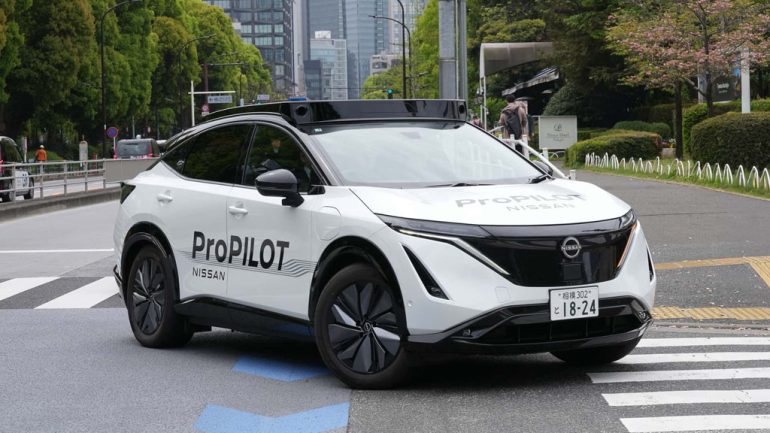
Reading through the early reactions from journalists who recently rode in Nissan’s latest hands-free driving prototype around Tokyo, the biggest takeaway is not that the technology felt flashy or futuristic. It is that it apparently felt normal. In the world of advanced driver assistance and autonomy, that may be the highest compliment possible. When a vehicle can handle dense urban traffic without turning every moment into a white-knuckle event, that says far more than any marketing phrase ever could.
What these journalists experienced was Nissan’s new system known as AI Drive, a hands-free driver assistance setup that builds on the company’s broader ProPILOT efforts. Nissan is still keeping some of the technical details close to the chest, but the outline is clear enough. The system blends AI-based software with Nissan’s existing driver assistance know-how and a substantial suite of hardware, including 11 cameras, five radar units, and a roof-mounted LiDAR sensor on the Ariya test vehicle. From the outside, that hardware sounds serious. From the reports out of Tokyo, it also sounds like it is being used in a way that prioritizes smoothness over spectacle.

That matters because Nissan is not claiming this is a fully autonomous, no-human-needed solution. From what has been described, AI Drive sits somewhere in the gray area between a highly advanced Level 2 system and the lower edge of Level 3 capability. In other words, the person in the driver’s seat still needs to remain attentive, watch the road, and be ready to take over when needed. That distinction is important, especially now, when too many conversations about self-driving technology get ahead of what is actually possible in the real world.
Still, the hardware and software combination sounds promising. The cameras reportedly monitor the vehicle’s surroundings with 360-degree visibility extending roughly 40 to 50 meters in every direction, while the system updates its view of the environment every 100 milliseconds. Nissan also appears committed to LiDAR as an extra layer of confidence, especially for low-visibility conditions and more complicated urban situations. That alone sets its approach apart from some rivals that have chosen to lean more heavily on cameras only.

The real test, of course, was not a spec sheet. It was Tokyo. According to the account shared by the journalists, Nissan put the prototype through a 40-minute drive that included some of the city’s busiest and trickiest streets, with Shibuya serving as the headline act. That is not exactly the kind of environment where you can fake competence for long. Busy crosswalks, narrow lanes, parked delivery vans, cyclists, and unpredictable pedestrians tend to expose weak points in a hurry. Yet the reports describe a ride that stayed composed, measured, and surprisingly polished.
One moment in particular stands out from the write-up. The Ariya prototype reportedly turned into a narrow alley lined with partially parked vans, people unloading cargo, and pedestrians moving unpredictably near the curb. At one point, a woman suddenly crossed in front of the vehicle. From the back seat, the journalist said they barely registered her movement before the Nissan had already begun slowing down. The impressive part was not just that the vehicle reacted. It was that it seemed to anticipate the possibility before the crossing became an emergency. That kind of predictive behavior is where advanced driver assistance starts to feel genuinely useful.

The rest of the Tokyo drive sounds like it followed the same theme. The prototype reportedly navigated Shibuya Crossing without drama, waited patiently at crosswalks, gave cyclists appropriate room, and worked around vehicles obstructing lanes in a way that felt natural rather than robotic. That word keeps coming up when reading impressions like this: natural. For all the hype that usually surrounds hands-free technology, what people seem to appreciate most is when the system behaves with the kind of restraint and awareness a good human driver would show.
Another encouraging detail is that, aside from the initial starting and stopping procedure, the engineer behind the wheel apparently did not need to take over steering during the demonstration. That does not make the system production-ready overnight, and it certainly does not mean every city or every road will be this seamless. But it does suggest Nissan has reached a point where its technology can handle more than a tightly controlled proof-of-concept loop. Even if any demonstration route is carefully chosen, the unpredictability of Tokyo traffic still gives this test some real credibility.

Looking beyond the prototype itself, Nissan’s long game here appears ambitious. The company has signaled that it wants advanced hands-free capability to spread across a large percentage of its lineup over time, which opens the door for future applications in mainstream vehicles rather than just halo projects. In the nearer term, Nissan is also working toward automated mobility services in Japan, with plans that point toward pilot programs using Leaf-based vehicles in Tokyo later in the decade. That suggests the company sees commercial fleets and consumer vehicles as two sides of the same development path.
From our perspective reading about these first journalist experiences, the most compelling part of Nissan’s AI Drive project is that it does not sound like science fiction. It sounds like a very serious effort to make hands-free driving feel calm, useful, and approachable in one of the most demanding urban environments on the planet. That is still a long way from true door-to-door autonomy, but it is also a meaningful step closer than many skeptics might expect. If Nissan can take what impressed journalists in Tokyo and scale it into something dependable for everyday buyers, this technology could become one of the brand’s most important breakthroughs in years.
“}]]
Reading through the early reactions from journalists who recently rode in Nissan’s latest hands-free driving prototype around Tokyo, the biggest takeaway is not that the technology felt flashy or futuristic. Full Article » Read More Automotive Addicts