
[[{“value”:”
Dali Sonik 1: Two-minute review
Dali’s new Sonik series of speakers is the Danish brand’s re-introduction to the global hi-fi market — and these, the Dali Sonik 1, are a set of versatile, broad-appeal passive bookshelf speakers aimed squarely at the entry-level audio enthusiast. They enter a saturated market at this size and price, rubbing shoulders with about every major speaker brand you can name; still, they stand apart and more than hold their own.
Clever driver and cone designs, refined from Dali speakers past, provide a surprising quality of sound, from clear and distortion-free articulation to smooth, natural-sounding mids and highs. Everything shines through these, but vocals benefit perhaps the most.
Transient performance is nothing short of delicious, and the low end is surprisingly supple for the size of the units (helped along by some very enthusiastic bass reflex ports). There’s a chance that the Sonik 1 are a little over-eager with respect to high end, but it’s marginal — and minimal against the robustness and throat on display in denser mixes.
Being a curmudgeonly sort, I tried my best not to love these speakers at first listen. I failed. It’s love. From the clear attention to detail shown in their design and build to the stunningly versatile sound performance, the Dali Sonik 1 are an overperforming pair of almost-budget bookshelfs. And definitely among the best stereo speakers on the market.
Dali Sonik 1 review: Price & release date
- Released February, 2026
- Priced $900 / £449.99 / AU$849
Do you ever feel like the Scandinavians just do it better? From my distant and semi-ignorant perch in deepest West Yorkshire, in the UK, I can’t help but feel like it’s true. Whether its education, taxation, or straight-up happiness, the concept of Nordic exceptionalism is very real indeed – and we’ve got even more proof right here in the land of domestic hi-fi audio, thanks to the landmark Danish audiophile loudspeaker industry frontrunner, Dali. Which stands for, er, Danish Audiophile Loudspeaker Industries.
Dali has been designing speakers from the ground up since the early 80s, and has established a well-earned reputation in that time. Its speakers touch every point of the hi-fi market, from budget-friendly fare to audiophilic bucket-list bookshelfs and beyond. Its roster of speakers is broad, deep and a little intimidating to reckon with — which is, in part, why it came out with this in February 2026: the Sonik series of passive speakers.
The Sonik series is Dali’s full and formal self-introduction to a global audience, taking everything it’s learned in its 40-ish years of loudspeaker development and cramming the best into a budget-spanning set of new flagships. There are seven different sets in the Sonik series, a comprehensive spread encompassing standmount, floorstanding and home cinema-friendly models. Whatever it is you want or need, chances are you’ll find it here.
Of these, the Dali Sonik 1 are proudly the smallest and cheapest of the bunch: a set of bookshelf standmounts that are dinkier than they look, and also much more powerful than that deceptive dinkiness would suggest. At $900 / £449.99 / AU$849, these aren’t the cheapest bookshelf speakers money can buy (especially in the US!), but they’re more or less in direct competition with entry-level bookshelf fare from practically every other hi-fi brand going; from Klipsch’s RP-600Ms to KEF’s Q1 Metas to Bowers and Wilkins’ 607 S3s to umpteen other austere offerings.
It’s a tough crowd, but one that Dali’s been quietly besting in a few key areas for a long time. In this competitive loudspeaker arena, will Nordic exceptionalism prove itself again?
Dali Sonik 1 review: Specs
|
Type |
Bookshelf |
|
Active or passive? |
Passive |
|
Bi-wirable |
No |
|
Woofer |
5.25-inch Clarity Cone wood fiber; SMC driver |
|
Tweeter |
29mm soft dome |
|
Impedance |
6 ohms |
|
Dimensions |
274 × 162 × 231mm |
Dali Sonik 1 review: Features
- Small-format bookshelf speakers with two-way crossover
- Patented cone design for smoother mids
- Remarkably low distortion, via proprietary driver composition
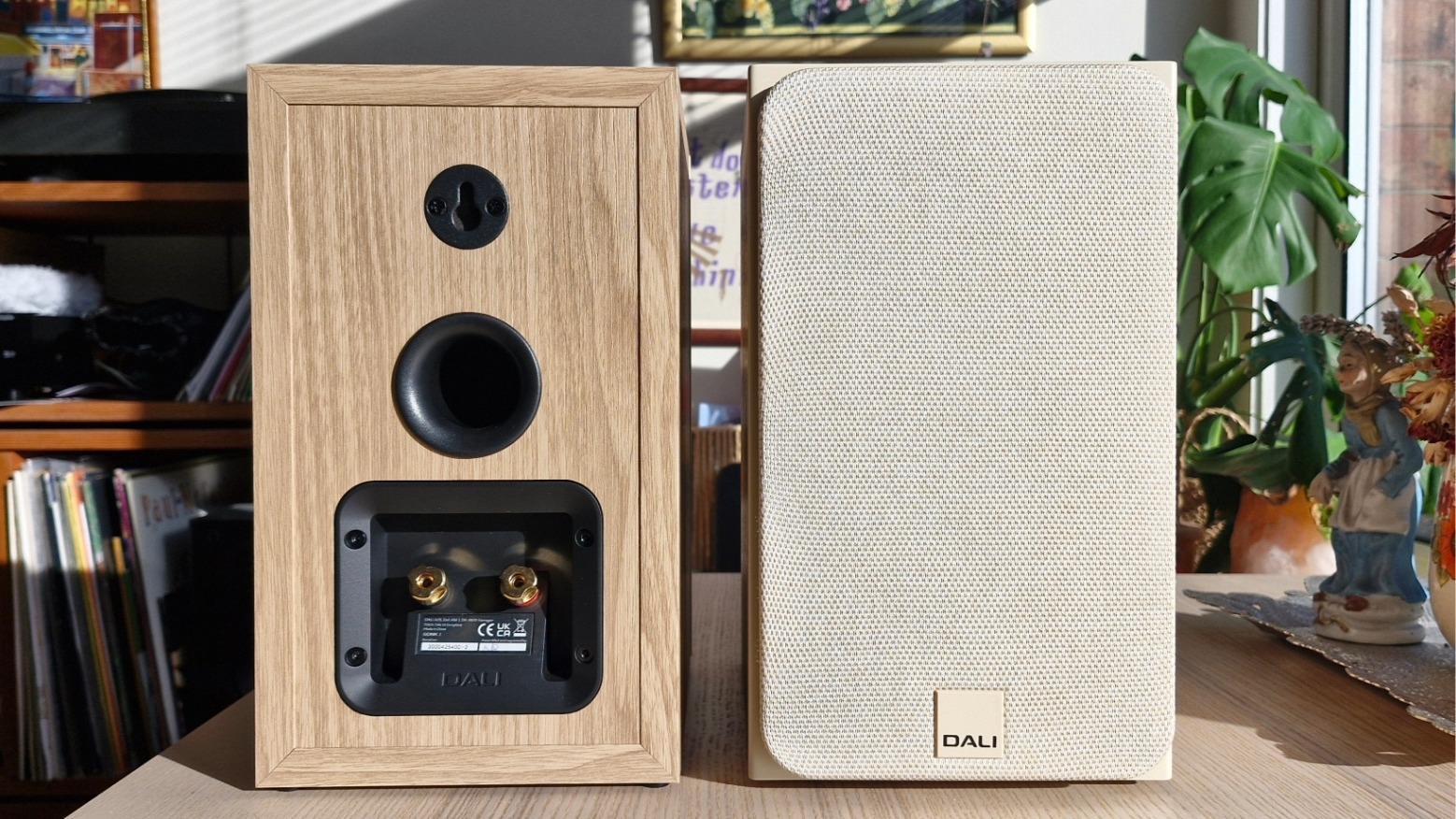
The Dali Sonik 1 are a pair of passive bookshelf speakers, with a two-way crossover involving a 29mm soft-dome tweeter and a 5.25-inch woofer, and a ported bass reflex chassis. They’re single-wire connectable, as opposed to bi-wirable; unless you have grand and arcane plans of driving tweeters and woofers separately, I don’t consider this in any way a shortcoming — and if you actually do have such plans, you are surely looking in the wrong price range.
Being passive, the Sonik 1’s features are almost entirely found in their clever composition, which hides some smart proprietary bits and pieces behind those optional magnetic cloth grilles. For instance, the whole Sonik series, Sonik 1 included, benefits from Dali’s trademarked Clarity Cone technology (taken from the Kore range that came before), wherein the speaker cones are made using a proprietary paper/wood-fiber blend, said to improve mid-range smoothness among other things.
There’s another trademarked feature, too, in the “SMC” (Soft Magnetic Composite)-assisted magnet systems that constitute the driver. Dali’s patented composite sits in the voice coil, significantly reducing distortion in the process. Collectively, these in-house divinations deign to create a fulsome, highly natural-sounding set of standmounts.
The Sonik 1 are the smallest of the Sonik series, and quite slender even for their size. It’s a small surprise settling them in to their respective homes and having some room to spare — but still, there’s a sense that they’re certain to punch above their weight class as soon as you take them out of the box.
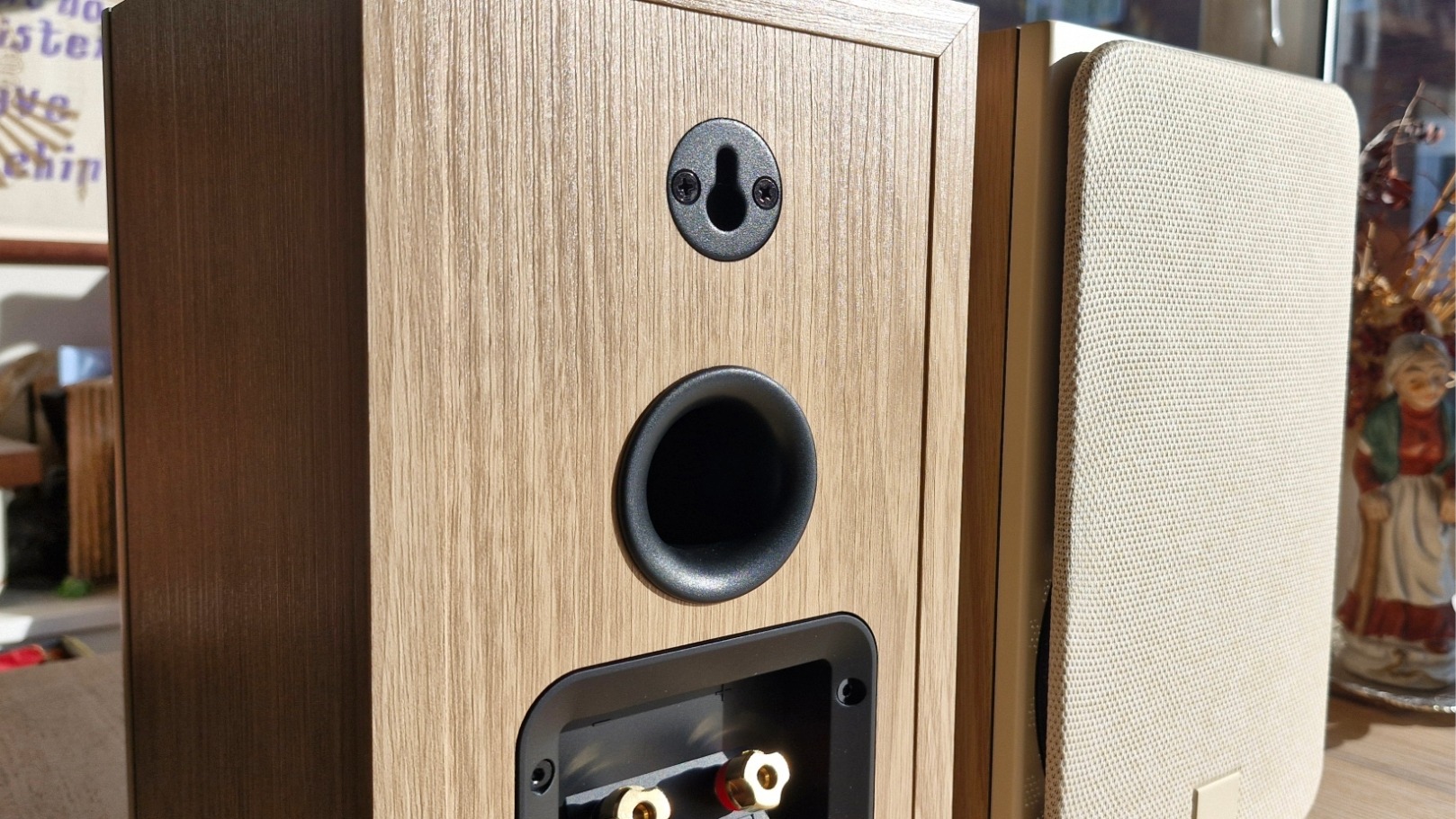
Speaking of which, there’s not much here in the way of box candy (no speaker cables, either). That said, they do ship with two sets of stick-on rubber feet: small, squashy black ones for standing them on your shelf of choice, and some thick, translucent ones for sticking on the back if you intend to wall-mount them. I’m not one for wall-mounting them just yet, but I was nonetheless touched that Dali elected to send clear stand-offs so as not to cause unsightly shadows if you do hang them.
That particularly small-beers inclusion is, for me, a perfect crystallization of Dali’s approach with the Sonik 1, and a reflection of its journey to this point. Small things, offered without ceremony, that add up to a thoughtful and gratifying whole.
- Features score: 5/5
Dali Sonik 1 review: Sound quality
- Smooth, dulcet vocal reproduction
- Deep, reflex-assisted bass
- Transparent treble and tactile transients
Dali talks a big talk about the natural sound of the Sonik series. As someone that also works on the other side of the mixing desk from time to time, it’s hard to describe what makes something sound ‘natural’ as anything other than a neutral approach to representing exactly what was recorded. Hi-fi devices are not typically designed to do this, either; they’re designed to flatter. They accentuate the bits that gratify us, giving us more to grab onto than a flat-response set of monitors would dare to. And yet…
To reach for a sense beyond natural, the Sonik 1 do some marvelous things, from delicate treatment of higher highs to a round, robust treatment of reedier sounds. It’s the voices, really, that shine, with no undue thanks to those Clarity Cone woofers; my household’s vinyl copy of Mitski’s Nothing Is Happening To Me has been on heavy rotation, and rendered in disturbingly effective heartbreaky three-dimensionality each and every time, since I installed the Sonik 1 pair.
Cats is a long, soft-silk ribbon, pulled deftly through my left ear and out the right. If I Leave’s brief crescendo of deep-gritted guitars and chest-voice urgency is a weighty presence in the room. B-side opener and second single, I’ll Change For You, is an honest-to-god tearjerker with thanks to an exceptionally tangible rendering of that stunning lead line – Mitski’s voice honestly feeling as if it floats forward through the mix, drifting airily on its own delusive train of thought. Brain-scratchingly good stuff.
Spinning the 10th anniversary repress of Adult Jazz’s Gist Is, I got a real feel for the Sonik 1’s handling of space. The richness of that midrange lends itself to roomy sounds, in which Gist Is, a patchwork of heres and theres, readily revels. Sparse, clever instrumental arrangements are articulated with fullness — illustrating some tactile transient responsiveness just as much as a natural, earnestly flattering representation of timbre.
The cheeky-swung drums on opener Hum are a bright, effervescent presence; cymbal crashes and open hats fizz in Am Gone. Slow-burner Spook is a highlight, rendering powerful dynamic shifts and slow-developing ambiences with a sense of unbothered expertise. Palm-muted guitars spike through like football cleats through turf, and legato lead lines skate sharply across the crescendo as if on six feet of ice.
Dali commits to harnessing low end wherever and however it can, leading to some extremely impressive bass performance from speakers that have neither the stature nor the right. There’s a little weight missing, and the bass reflex port is doing a lot of heavy lifting to replace it (aided, no doubt, by the sub-optimal listening position in which the Sonik 1 lived for most of my testing), but even without that telltale pumpy bluster, there’s a lot to love about the structure of the heft they possess.
If I were to find anything to complain about with the Dali Sonik 1, it would end up being a slight high-end over-presence. The treatment of trebly sources is delicate, considered and even fastidious, but sometimes, to the point of clear preference over other elements of a mix. This is emphasized further by that slight lack in the low end, countered by an eager bass reflex.
But here’s the thing: I feel like I’m reaching. Putting on one of the more chaotic records in my vinyl collection — My Bloody Valentine’s Loveless — I’m greeted with unexpected clarity and cohesion. Everything’s resolved as it was, is and should be, from brain-swallowing yet still-punchy lows to screeching uber-compressed wall-of-guitar highs. It’s a high-performing pair, through and through.
- Sound quality score: 5/5
Dali Sonik 1 review: Design
- High attention to detail
- Clever attachable grille
- Cool, understated looks
Dali’s full-spectrum approach to design and manufacture means the same care and attention is given to the development of each product in their roster, as gamely demonstrated by the quality on display with the Sonik 1.
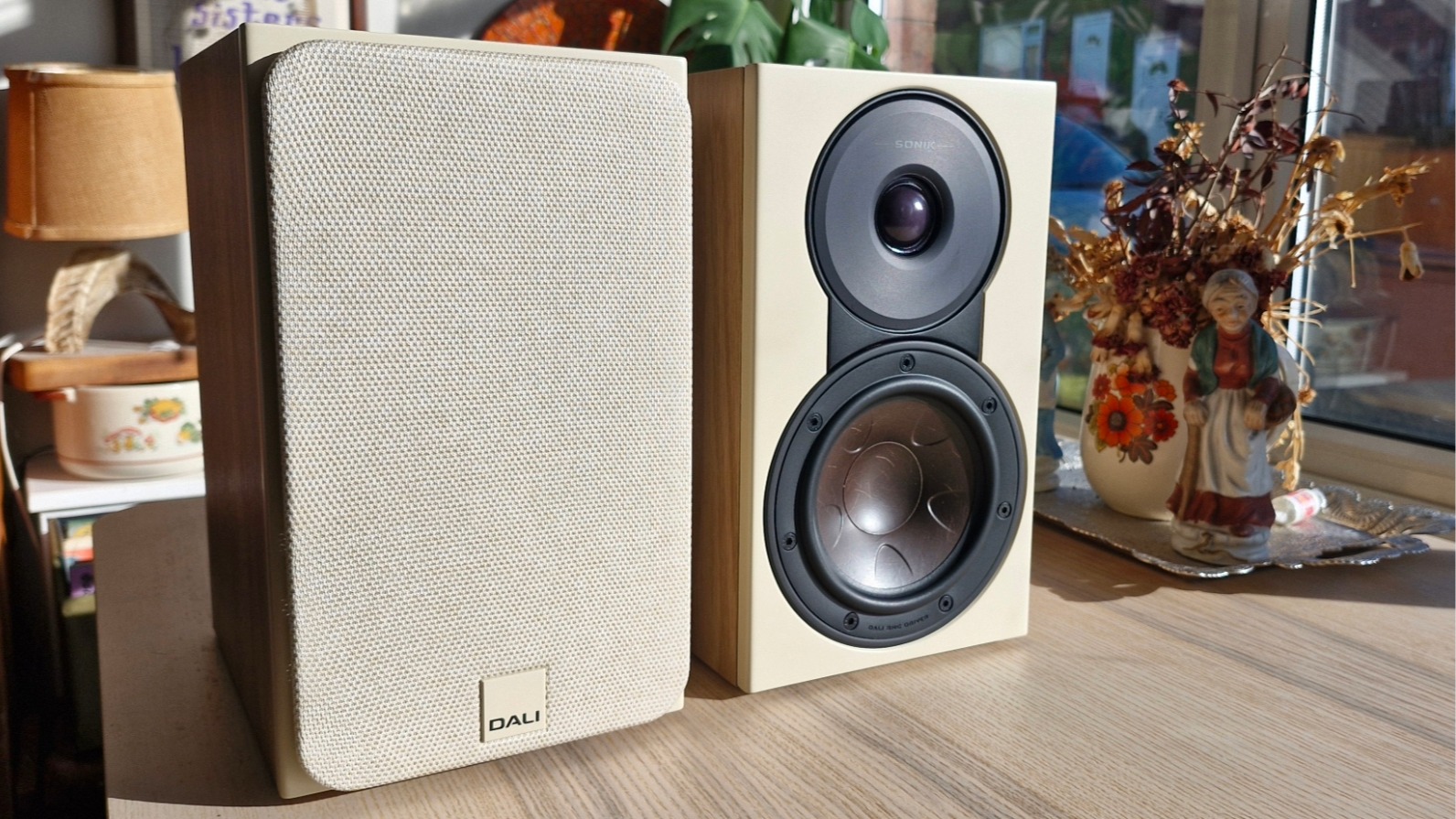
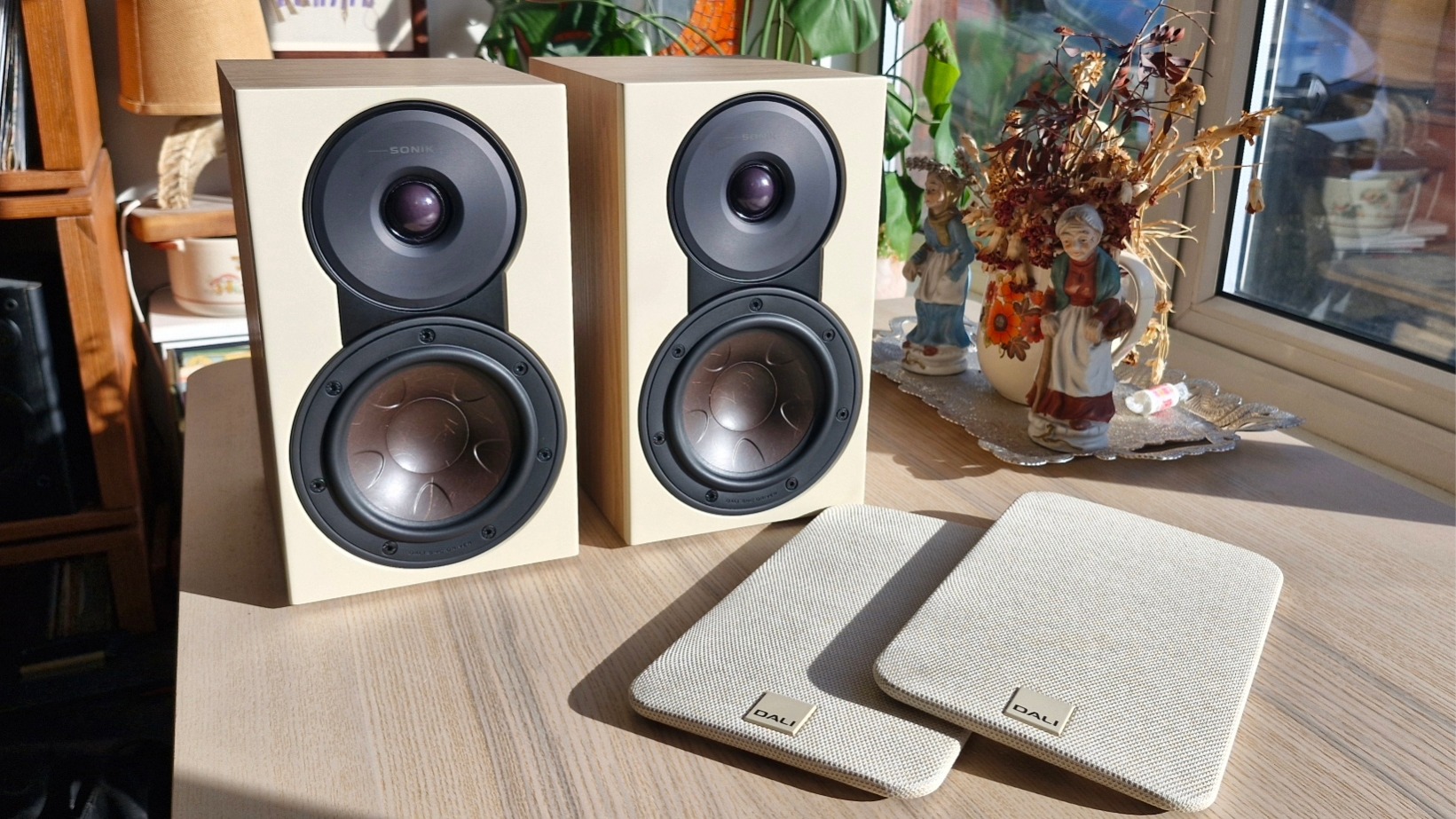
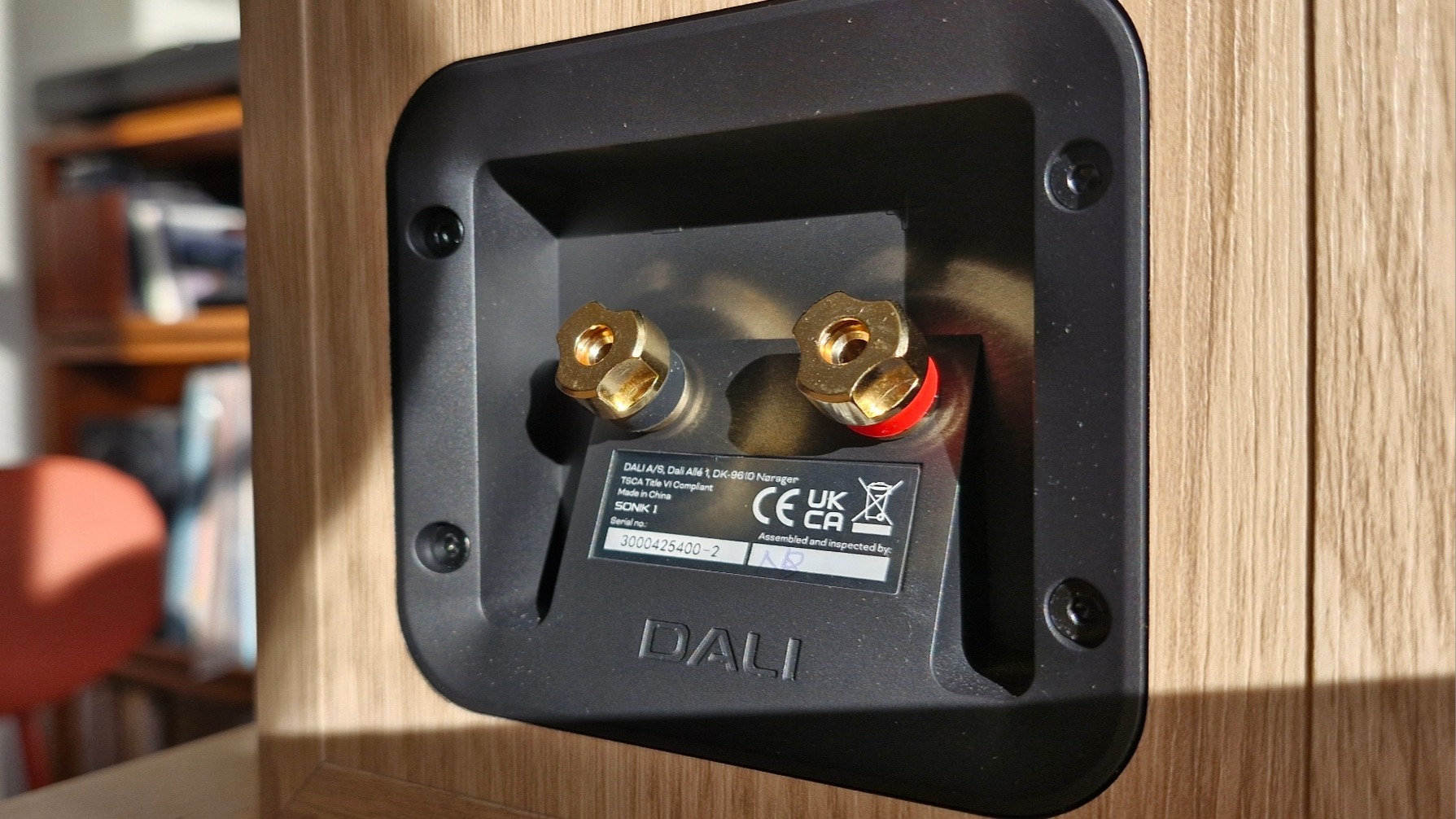
There’s attention to detail wherever you look, be it the chunky brass terminals at the rear or the tastefully radiused face-plates at the front. Really, these are tasteful-looking through and through. The pair under review are the natural oak variant version, but you can also pick these up in white, black ash or walnut. With mine, a cream front face is gamely disrupted by bold black driver surrounds, accentuating the presence of that cool burgundy woofer cone.
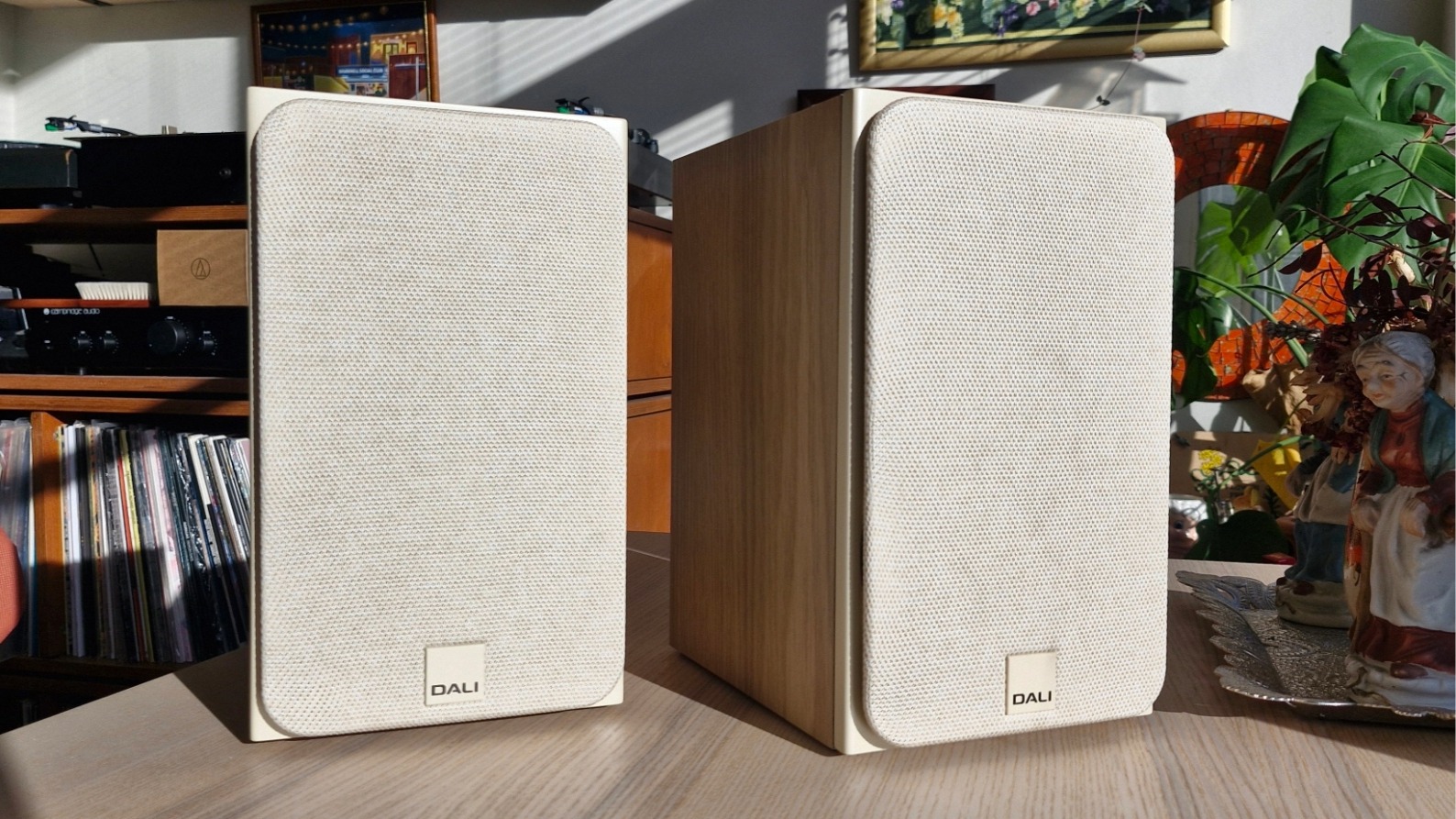
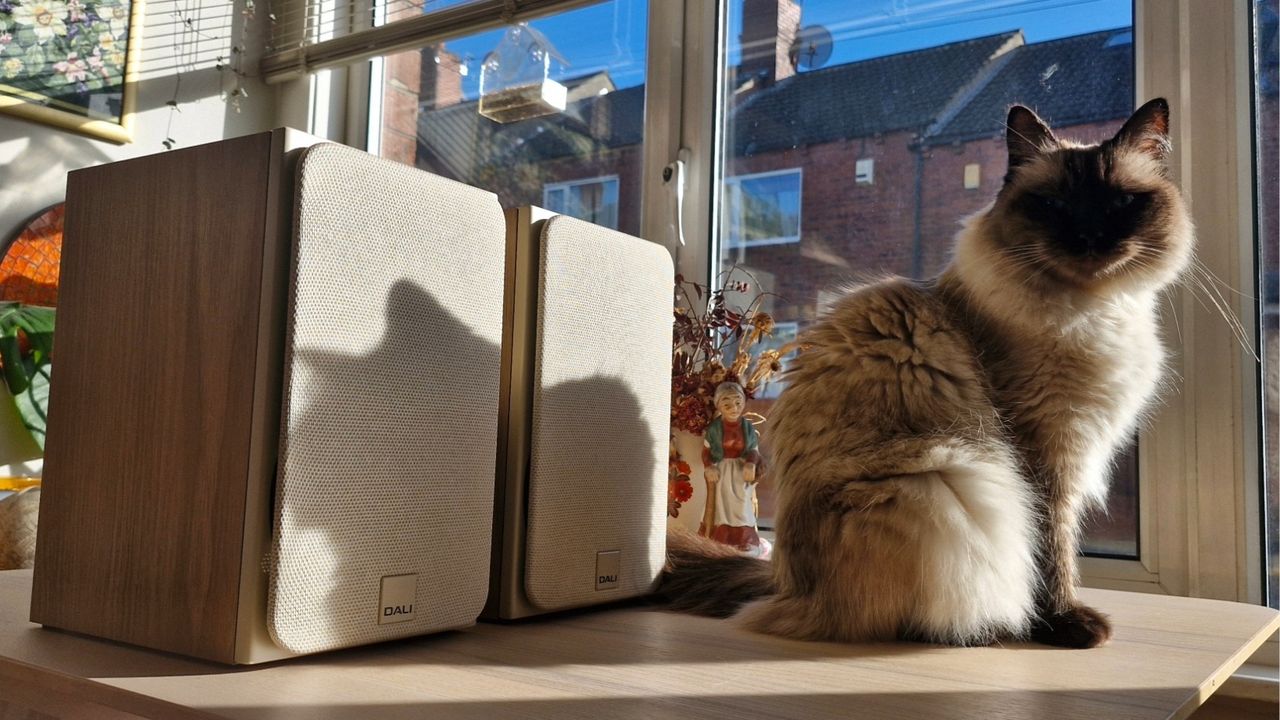
The included cloth grilles are a mottled off-white, and attachable (as is becoming increasingly common) with magnets; this leaves a smooth face on the speakers, and makes for a posh-feeling set overall. With the grilles on, the Dali Sonik 1 become coolly understated; they fade amenably into the figurative milieu of your living room, and shine all the more prominently on their acoustical merits.
- Design score: 5/5
Dali Sonik 1 review: Value
- A familiar price for entry-level audiophile fare
- Incredible performance for budget
- Impossible not to like
Generally speaking, and whichever way you slice it, $900 / £449.99 / AU$849 is a lot of money to ask someone to pay for something. But it’s the de facto floor price (excepting that tariff-y US-import price) for something good in the audiophile hi-fi space. When big numbers get bandied around for confoundingly clever loudspeakers further up the chain, it’s easy to lose sight of the real ask here for the average consumer.
Every brand that puts out an entry-level artefact of posh loudspeaker design at this price, then, has to be able to justify it. And most of the heavy hitters do, pulling down top-flight innovations to an affordable price and walking the walk on sound quality (Bowers and Wilkins’ 607 S3 being a chief competitor and major example). And just as most of the heavy hitters do, so too does Dali.
The Sonik 1 are as smart a pair of bookshelf speakers as you could ask for. They’re deeply versatile, deep-sounding despite their stature, and delightful to listen to. The frequency response reflects a hyper-natural richness, without overrepresenting anything too nakedly. They fill small and medium spaces capably, handle loud signals with minimal distortion, and deliver gratifying performance from wherever you sit or stand.
These speakers are an excellent example of what investing in hi-fi can actually mean for someone. The articulation and fidelity on display is demonstrably far, far better than cheaper fare you come across. The Sonik 1 may be the entry-level pair in a large family of new broad-appeal loudspeakers, but they’re as refined as you could ever want in a mid-range listening setup. They look the part, yes, but they feel the part, too.
To be blunt, I went into this review with a harshly critical eye. It was softened instantly, by a self-assured set of speakers that elevated my home hi-fi without ceremony. Dali is doing some incredible work reinstating the importance of attention to detail, of pride in a product, via a seamlessly well put together set of speakers that actually exceed their expectations.
- Value score: 5/5
Dali Sonik 1 review: scorecard
|
Comment |
Rating |
|
|
Features |
A 29mm soft dome tweeter and a 5.25-inch woofer with a proprietary driver and cone design, plus a diminutive footprint. |
5/5 |
|
Sound quality |
Speakers that have no right sounding how they do. Full articulation, with impressive clarity of vocals; rich and robust low end; dynamics handled naturally. |
5/5 |
|
Design |
Understatedly gorgeous, with a seamlessness that reflects build quality as well as aesthetic nice-ness. |
5/5 |
|
Value |
Even though the cheaper end of the spectrum for ‘decent’ hi-fi passives is quite pricey, they represent nothing but value for money. |
5/5 |
Should you buy the Dali Sonik 1?
Buy them if…
You want capable, versatile performers
The Dali Sonik 1 are broad-appeal bookshelfs, with a decidedly ‘natural’ sound profile. They work well wherever you put them, whatever you put through them and whatever volume you like (within reason). They’re low distortion, high fidelity and hard to flap!
You like crooners
Voices are articulated with astonishing accuracy and presence, alongside strings and reedy things. Your heartbreaking Americana records will never sound better below $1000 (just).
Don’t buy them if…
You’re a bass-hunter
The low end is certainly remarkable with the Dali Sonik 1, but that’s with respect to their size. They rely (sometimes overly) on their thick, pumpy bass reflex ports to build out the subby stuff, so you may want to size up if that’s your bag.
The price makes you think twice
Nothing’s worth stretching a budget hard for, and the Dali Sonik 1 are no different. Dali has cheaper, more accessible bookshelfs that offer tantalizing glimpses at the very same quality on display here — if money is an object, consider going for the Kupid instead.
Dali Sonik 1 review: Also consider
|
Dali Sonik 1 |
Bowers & Wilkins 607 S3 |
Kanto Ren |
|
|
Price |
$349.99 / £279.99 (approx AU$570) |
$369.99 / £329.99 / AU$449 |
$599 / £599 (around AU$1,199) |
|
Type |
Passive bookshelf |
Passive bookshelf |
Passive bookshelf |
|
Bi-wirable? |
No |
Yes |
No |
|
Woofer |
5.25-inch Clarity Cone wood fiber; SMC driver |
130mm Continuum mid/bass driver |
114mm wood-fiber/paper mid/bass driver |
|
Tweeter |
29mm soft dome |
25mm titanium double-dome |
26mm soft dome |
|
Impedance |
6 ohms |
8 ohms |
4 ohms |
|
Dimensions |
274 × 162 × 231mm |
300 x 165 x 207mm |
245 x 150 x 198mm |
Bowers & Wilkins 607 S3
The Bowers & Wilkins 607 S3 are the vaunted speaker brand’s new flagship for entry-level audiophilia, and an excellent set of passive bookshelfs in their own right. They share some things vaguely in common with the Sonik 1, from a preference for high end to a slightly demanding price point — but they’re bi-wirable, too.
Read our full Bowers & Wilkins 607 S3 review here
Dali Kupid
If $900 / £450 is a little rich for your budget, Dali has you covered. The Dali Kupid passive bookshelf speakers are even budget-ier, and carry a lot of the same DNA. Concessions are made, of course, but these entry-level standmounts still got full marks from us.
Read our full Dali Kupid review here
How I tested the Dali Sonik 1
- Tested for 6 week(s)
- Used as main living-room listening speakers
- Predominantly tested using vinyl records, played on Vestax turntables; also with CDs and hi-res streaming from Qobuz
The Dali Sonik 1 bookshelf speakers found their home at the epicenter of my living-room listening station, where they were hooked up to my Cambridge Audio A2 integrated amplifier, and received audio from a variety of sources — most commonly, vinyl records played through Vestax PDX-D3 turntables (outfitted with Audio-Technica AT-VM95E cartridges) and a Vestax preamp and mixer.
I listened to CDs using a FiiO DM13 CD player, and I threw some hi-res streaming from Qobuz in there for good measure, too, via a 3.5mm jack from my laptop to the Vestax mixer.
First reviewed: April 2026
Read more about how we test at TechRadar
“}]]
 The Dali Sonik 1 entry-level passive bookshelf speakers sound at least twice their diminutive size with stunning vocal articulation, but are a little pricey. Read More Latest from TechRadar US in Reviews