
[[{“value”:”
Windows Latest recently tested Windows 11’s hidden Low Latency Profile feature, proving that it is an absolute game-changer for budget PCs. I saw the CPU frequency temporarily maxing out for one to three seconds while opening menus and apps, and my low-powered VM felt incredibly snappy and responsive.
However, despite the clear performance benefits, the internet reacted with a predictable outrage (because it’s Microsoft). Users accused Microsoft of using a “band-aid” fix, claiming the company is just brute-forcing a bloated operating system instead of optimizing the foundational code.
If you aren’t aware of it already, Low Latency Profile is a hidden feature in the latest Windows 11 Insider builds that temporarily ramps the CPU to maximum frequency for one to three seconds whenever you trigger a high‑priority interaction such as opening apps, the Start menu, or context menus.
Low Latency Profile is part of Microsoft’s plan to boost Windows 11 performance, which also includes optimizing legacy code and migrating more UI to WinUI 3. It’s currently an automated background behavior with minimal reported impact on battery and thermals. The feature is under early testing, and we’re not sure when it will arrive for all PCs.
The backlash over this new speed boosting trick grew so loud that Microsoft VP and Member of Technical Staff, the legendary Scott Hanselman, personally stepped in on X to set the record straight.
Yes, his responses effectively confirm that Microsoft is actively working on the Low Latency Profile feature, and also serve as a brutal reality check for keyboard critics who fundamentally misunderstand how modern computers work.
The “Fake Performance” conspiracy of Low Latency Profile
The main complaint that I saw online is that temporarily boosting the CPU to open the Start menu is somehow “cheating” or a sign of terrible software engineering.
Hanselman shut this down, pointing out that this behavior is an industry standard. “All modern operating systems do this, including macOS and Linux. It’s not ‘cheating’; this is how modern systems make apps feel fast: they temporarily boost the CPU speed and prioritize interactive tasks to reduce latency,” he explained.
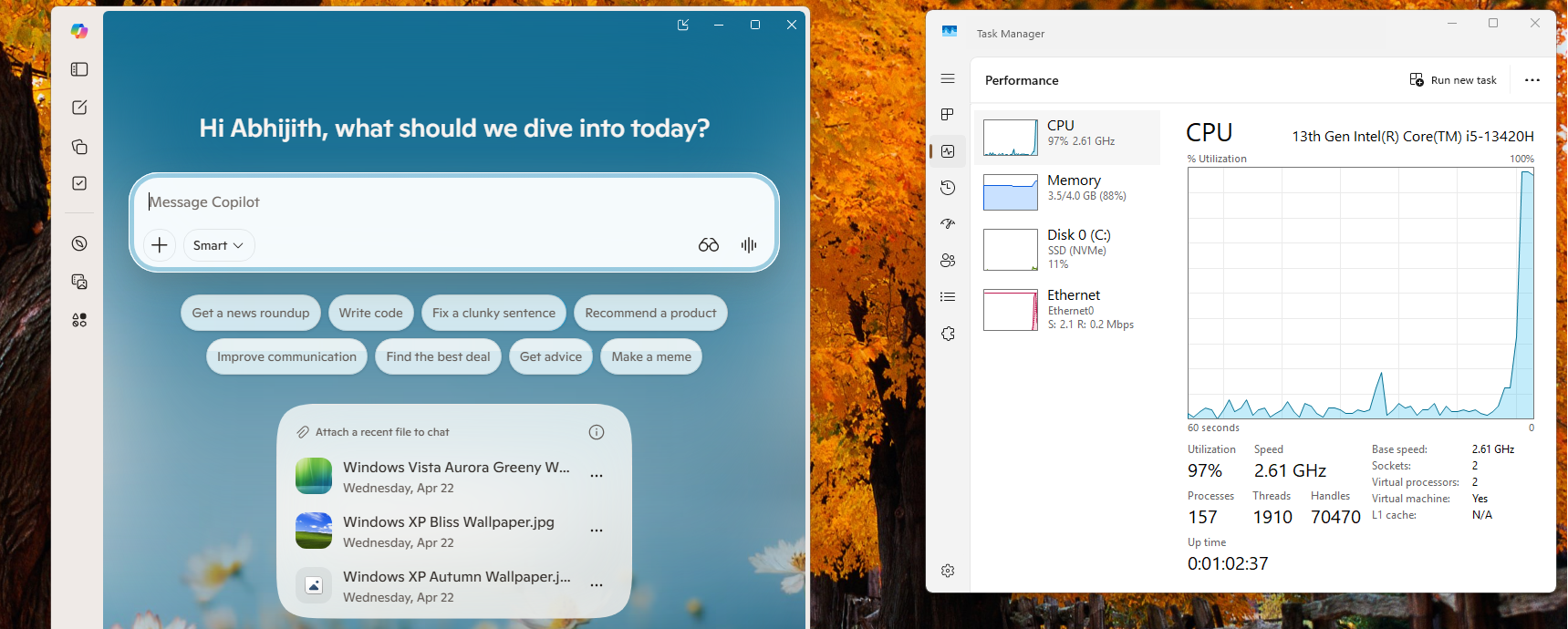
When people continued to complain, Hanselman had a funny and accurate take on the situation: “There are actual things wrong and smart people are working to fix them, but a lot of this negativity is computer science enthusiasts without experience in computer science making assumptions based on their intuition.”
To be honest, this was exactly what I also felt. Microsoft’s enshittifiction of Windows 11 got so bad to the point where even if the company does something positive, critics, with basic knowledge, come up with baseless explanations about how it’s something negative.
But Scott didn’t stop at people, though…
He went after the Elon Musk-owned AI, Grok, when the chatbot falsely claimed that Linux desktops handle menus with zero CPU spikes. Hanselman schooled the AI, noting that Linux achieves its responsiveness through the same methods, using the kernel scheduler, CPU frequency governors, and modern CPU boost technologies like schedutil to wake faster cores the moment a user interacts with the UI.
And in that process, he also explained why Linux is faster:
“Linux menus can feel lighter because they often do less work and integrate fewer services, not because Linux somehow avoids CPU boosting or background activity. GNOME, KDE, and even app launchers on Linux still spike CPU, schedule foreground tasks aggressively, and use modern boost behavior exactly like every modern OS”
But of course, Linux isn’t Windows’s biggest competition:
When a user criticized Microsoft, presumptuously meaning to say that Low Latency Profile is not something worth announcing to the press and public, and giving it a name, Hanselman gave the most fitting reply:
“Apple does this and y’all love it,” he tweeted, challenging Mac users to run the sudo powermetrics command in their terminal to watch the same CPU boosting behavior happen in real time on macOS.
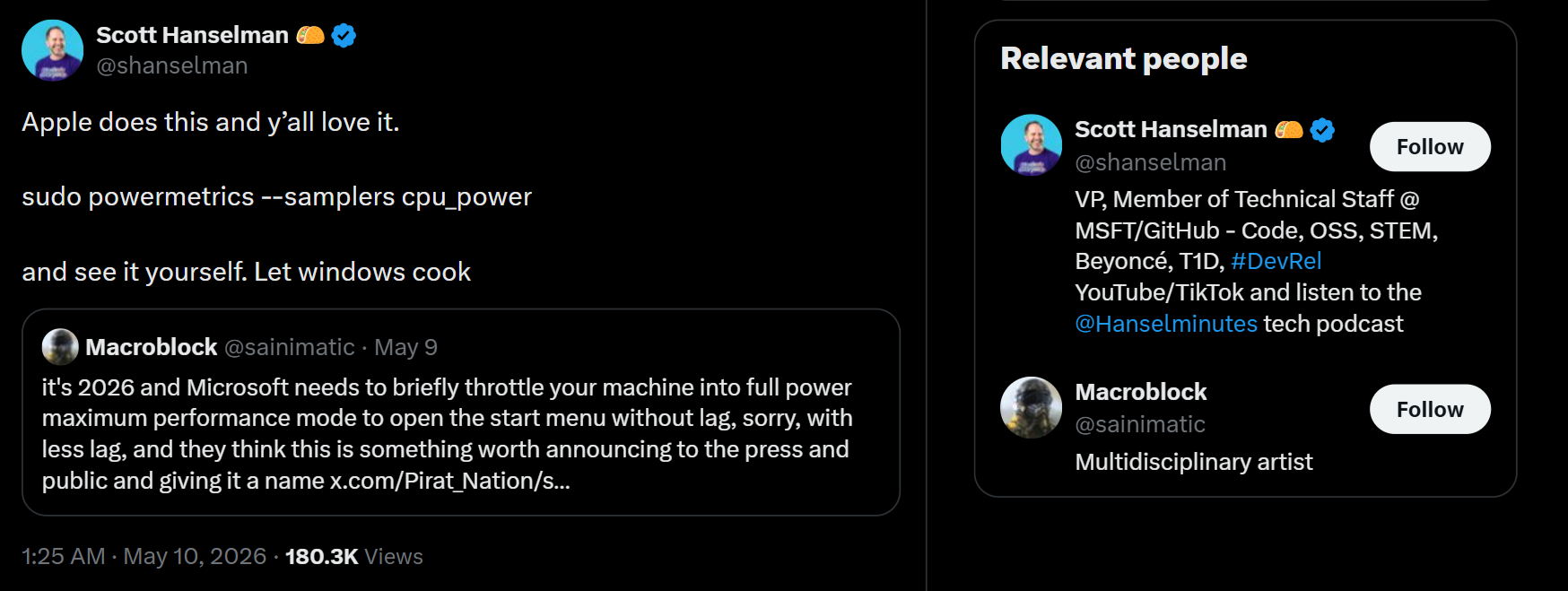 Sure, it’s easy to understand how such criticism arises, and it’s completely Microsoft’s fault. However, bandwagon criticism of an already established technology when a company you dislike adopts it is plain hypocrisy.
As Hanselman said in another of his slew of fitting replies: “Everything is a conspiracy when you don’t know how anything works.”
The “Race to Sleep” and why Low Latency Profile is better suited for Snapdragon PCs
One of the best explanations for why Low Latency Profile is a brilliant idea came from tech enthusiast Emily Young, who previously worked at Linus Tech Tips. She noted that running higher clocks over less time for a momentary load is generally much more efficient than running low clocks for a longer period.
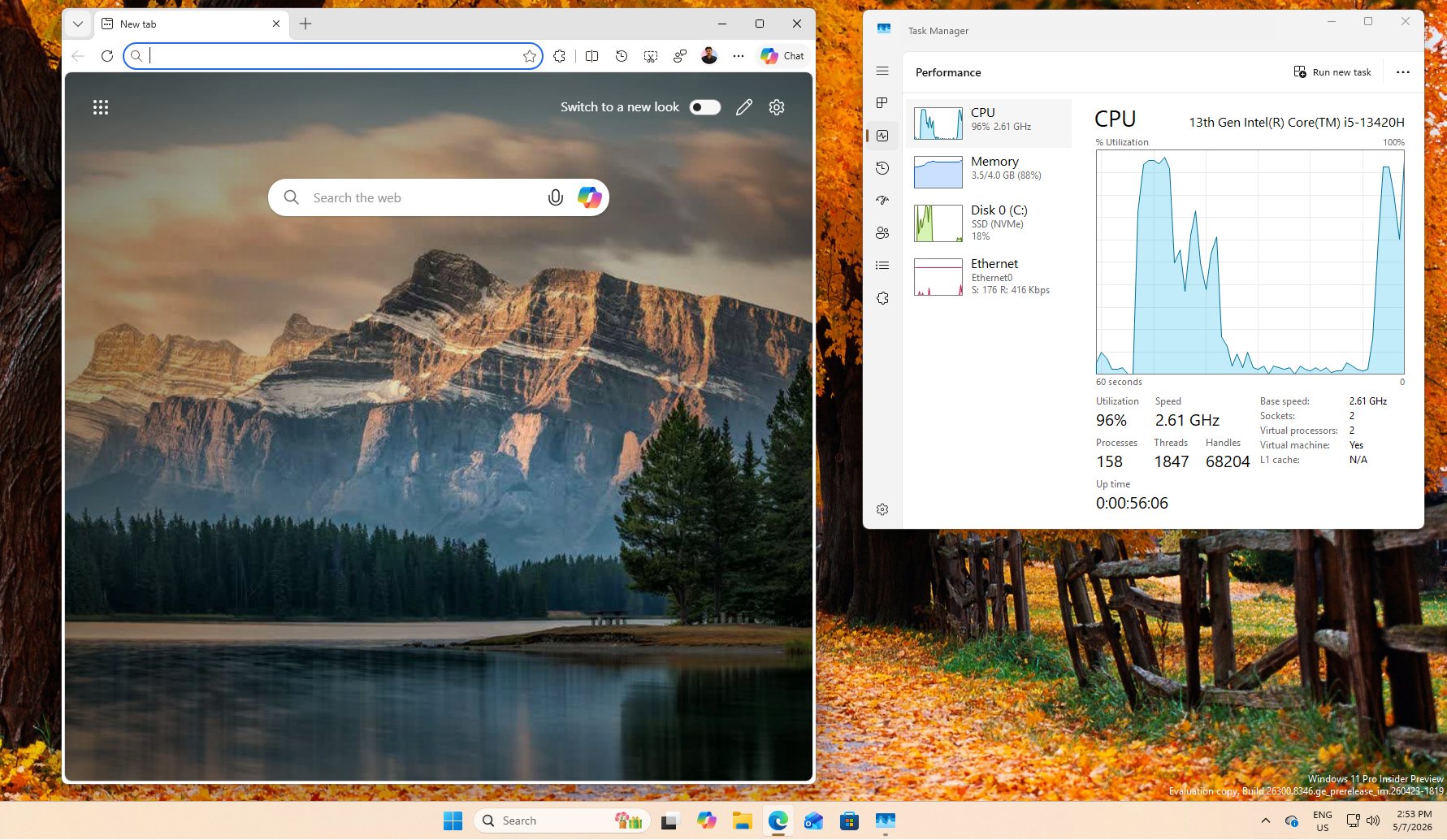
This concept is known as “racing to sleep.” By giving the processor maximum power to finish the task instantly, the CPU can return to its ultra-low power idle state much faster, ultimately saving battery life.
Interestingly, Hanselman confirmed that this feature will be especially potent on modern ARM architecture. When a user suggested that this feels far more acceptable on ARM than x86, Hanselman agreed. He explained that processors capable of shifting power states incredibly fast (like the Snapdragon X Elite chips featuring Unified Memory Architecture) will see this responsiveness boost much more dramatically than traditional x86 chips.

Note that Apple’s M series chips also have Unified Memory Architecture!
Why was Windows 95 Start menu faster without needing CPU boost?
As someone who has used Windows 98, XP, Windows 7, 10, and now 11, I know for a fact that the previous versions felt noticeably faster, and I share the same complaints while comparing Windows 11 and Windows 95, an OS that came out the year I was born!
Users voiced frustration that the Start menu opened instantly on ancient hardware running Windows XP or Windows 95, asking why a modern PC needs a turbo boost to do the same thing today.
“It totally is [frustrating], it has to do less stuff,” Hanselman admitted. “The reason that things were like that 30 years ago is that the start menu didn’t do anything. The trick to scale is to do less.”
He elaborated that older menus were essentially just unhiding a pre-rendered, fixed layout panel with zero DPI scaling changes and no network requests. Today, the Windows 11 Start menu is constantly pulling in recommended recent documents, cloud files, and web search results.
However, Microsoft knows the Start menu has gotten too heavy. Hanselman assured that there is a “full court press to make it faster with modern techniques” across a variety of disciplines, confirming our report about Microsoft actively shifting the Start menu away from heavier web components toward native WinUI 3 code.
Is Low Latency Profile good or bad?
If Microsoft were adamant on just boosting CPU speeds and avoiding any optimizations to Windows 11, then I would’ve agreed with the critics. However, that’s not the case. If you have been following recent Windows 11 news, you might have come across all the OS fixes that the company is up to, including making Windows 11 faster.
What everyone needs to understand from Hanselman’s masterclass in computer science is that Low Latency Profile is not an excuse to avoid optimizing Windows 11.
When users demanded that Microsoft remove all the bloat and optimize the apps first before implementing a CPU boost, Hanselman replied, “Or do both.”
Microsoft is a massive company capable of walking and chewing gum at the same time. As we have seen in the latest Insider builds, the development teams are actively stripping out legacy code, optimizing File Explorer, and rebuilding core components, like Run, in native frameworks, and still managing to make it faster than the legacy Run dialog.
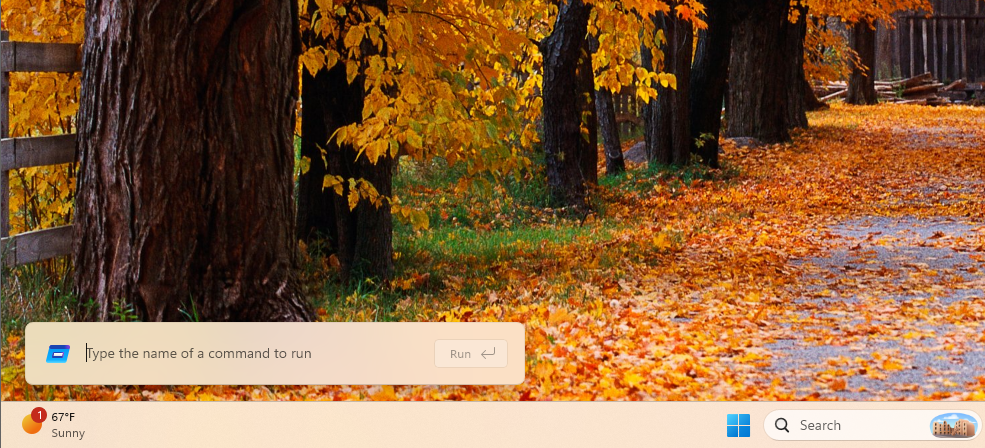
Low Latency Profile is just the cherry on top, meaning it’s good by itself, and it’s even better that we are also getting Windows 11 optimizations soon.
By combining properly optimized code with an aggressive, modern CPU scheduler that prioritizes user interactions, Windows 11 is finally going to feel as fast as previous versions. So, the next time someone complains about their CPU spiking when they open an app, just tell them to “study computer science”!
The post Microsoft denies Windows 11 CPU boost trick is a lazy fix, says Apple does this and you love it appeared first on Windows Latest
“}]]
[[{“value”:”After the internet criticized Windows 11’s new Low Latency CPU boost as a lazy band aid fix, Microsoft VP Scott Hanselman stepped in to set the record straight. Here is why temporarily maxing out your CPU is actually a brilliant industry standard that macOS and Linux have used for years.
The post Microsoft denies Windows 11 CPU boost trick is a lazy fix, says Apple does this and you love it appeared first on Windows Latest”}]] Read More Windows Latest