
[[{“value”:”
Nomad is a global travel eSIM provider offering prepaid data plans across a wide range of destinations, founded in 2020 by LotusFlare, Inc., and headquartered in Santa Clara, California. The travel eSIM market has quickly become crowded.
However, Nomad has maintained its position due to its clean app, honest pricing, and reliable coverage in places beyond just London and Tokyo.
The setup is quick, activation is straightforward, and the pricing sits well below what most domestic carriers charge for roaming. For the most part, it just works. Sure, you will come across the occasional complaint about slower speeds or patchy connectivity, but those feel more like exceptions than the general experience.
Nomad: Plans and pricing
Nomad’s pricing is based on data usage and destination, with rates starting at $0.66/GB for some European countries. That number is worth sitting with for a second, because most people assume travel data has to be expensive. It doesn’t, at least not with Nomad.
Here’s an overview of current starting rates by region:
|
Region |
Data range |
Validity |
Starting from |
|---|---|---|---|
|
Global |
1 GB-20 GB |
7-30 days |
$5.15/GB (123 destinations) |
|
Global-EX |
10 GB-50 GB |
10-365 days |
$2.17/GB (54+ destinations) |
|
North America |
Varies |
Varies |
$2.20/GB (US, CA, MX) |
|
Europe |
Varies |
Varies |
$0.66/GB (35+ destinations) |
|
Asia-Pacific |
Varies |
Varies |
$1.02/GB (14+ destinations) |
|
Africa |
Varies |
Varies |
$4.50/GB (11 destinations) |
The listed prices are really just your entry point. What you end up paying depends on how much data you need and how long you are away. Yes, if you are willing to figure things out after landing, a local SIM can sometimes save you a few bucks. But Nomad helps you sort it before the trip, land, switch it on, and your phone is already connected while everyone else is still standing around trying to get a signal.
Nomad: Features
Nomad keeps things lean on features, but what it does offer is well thought out. There is a subscription plan for Europe regulars, multi-device sharing, and a referral programme that actually pays out.
Nomad pass
If you travel to Europe more than once or twice a year, Nomad Pass is worth a close look. For $3/month, you get 1 GB of Europe regional data as a standing base, plus a 15% discount on any add-on plans you purchase. It is not a replacement for a full data plan on longer trips, but as a monthly subscription that keeps you covered for quick runs to London, Milan, or Amsterdam without having to buy a fresh plan every time, it is genuinely useful. (The latest version of the Nomad app is required to access it.)
Multi-device support
Nomad lets you share your eSIM data across multiple devices, which matters more than people realize until they’re trying to get their laptop online from a hotel room in Tokyo. Smartphones, tablets, and laptops: it works across all of them, and managing it stays within the same app.
Nomad perks and referral programme
Nomad runs a referral programme where both you and up to five friends each receive $5 off plans priced at $5 or more. It is a straightforward reward structure without the fine print gymnastics that make most referral programs frustrating. There are also broader perks and discounts on travel-adjacent services like accommodation and tours, which add value beyond the data plan itself.
Nomad: Installation
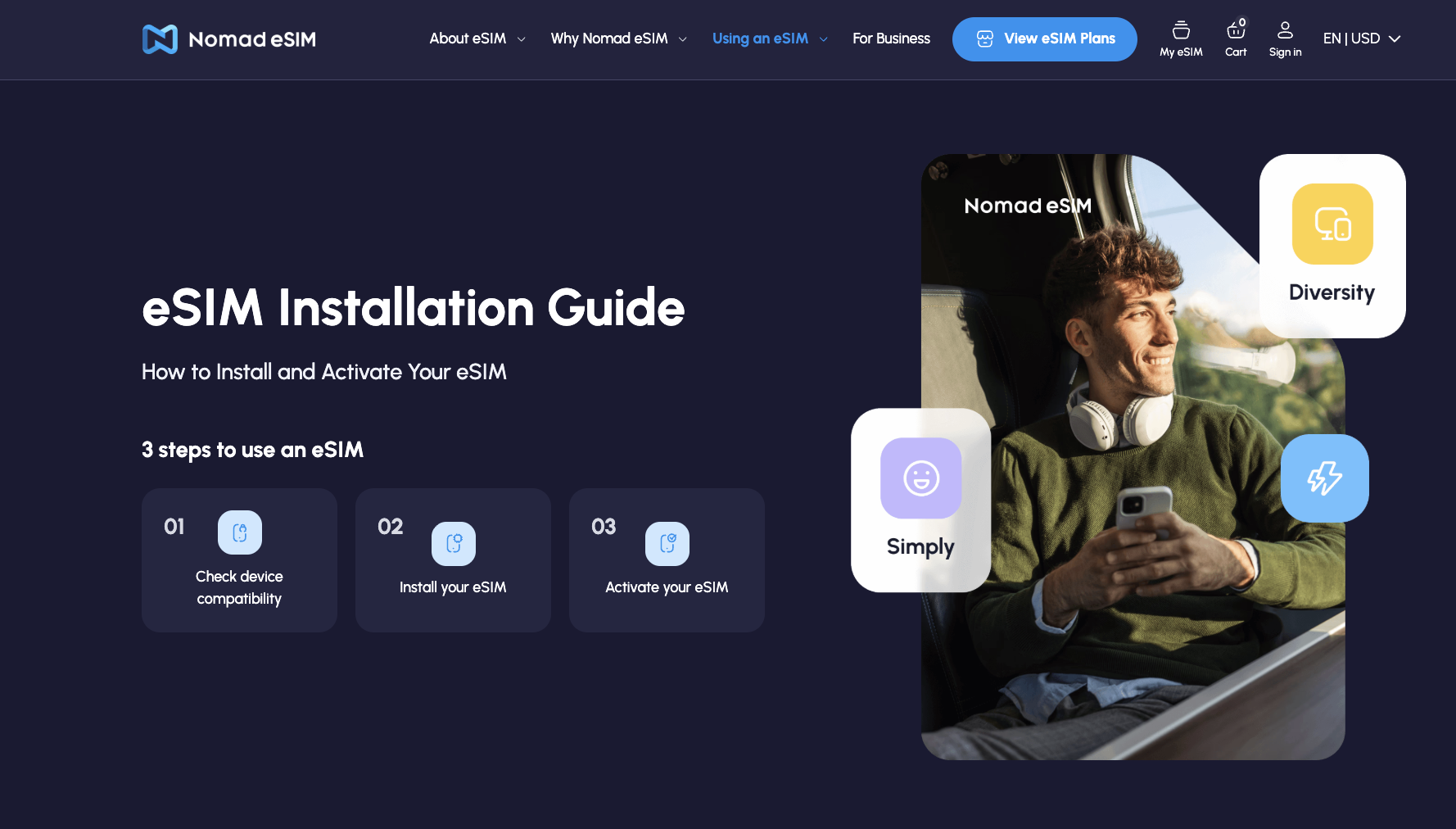
Buying and activating a Nomad eSIM takes a fraction of the time. You purchase through the website or the iOS and Android app, receive a QR code by email, scan it with your device, and the carrier profile installs itself. From there, activation is a few taps in your device settings.
The smarter way to use Nomad is to install your eSIM before you leave home, because the profile installs over Wi-Fi and you can set it to activate automatically once you land in your destination country. That means stepping off the plane and being connected before you reach passport control.
The one thing to watch: Activating your plan too early (before you’re actually in the destination region) will start burning your data allowance, so hold off on switching it on until you’re ready to use it.
Nomad: Coverage and speed
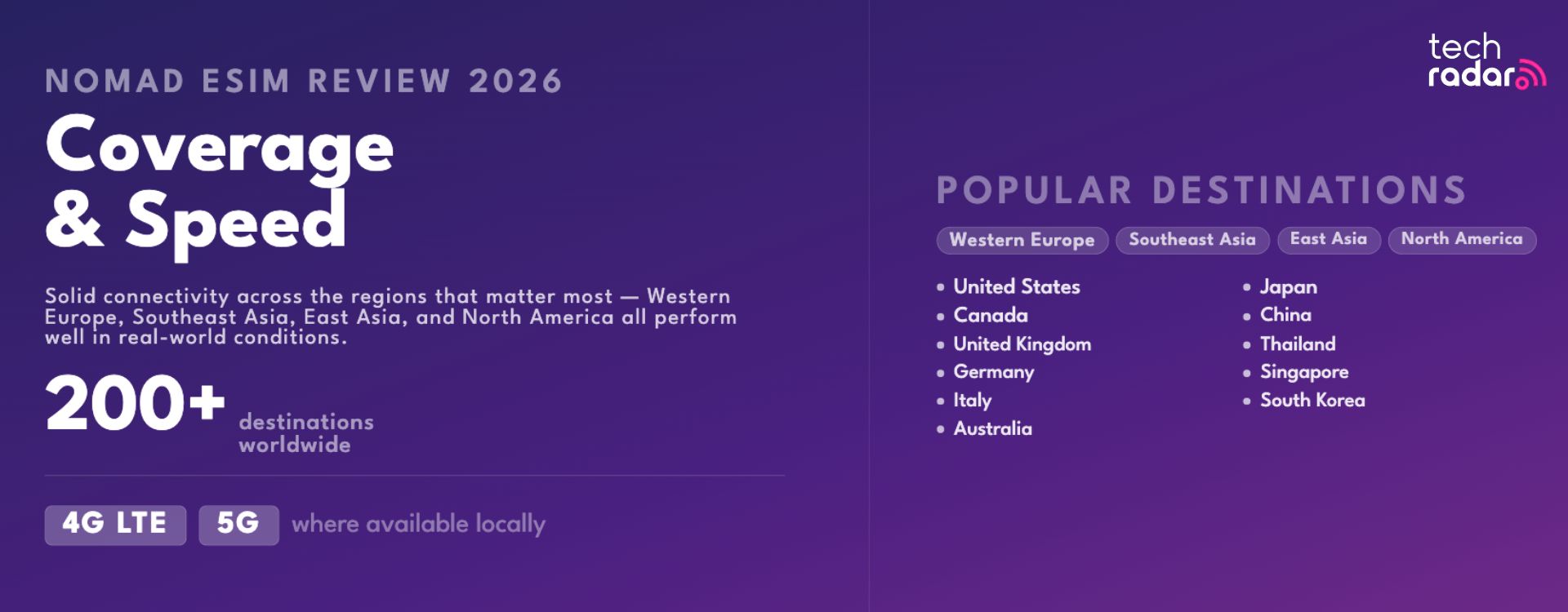
Nomad covers a broad range of destinations worldwide, putting it firmly in the top tier of travel eSIM providers by reach. Real-world connectivity is generally solid across the regions that matter most: Western Europe, Southeast Asia, East Asia, and North America all perform well in practice.
Regarding speeds, Nomad typically delivers 4G/LTE and 5G connectivity, with actual speeds depending on your destination and local network conditions at any given time. Peak-hour slowdowns in dense urban areas like Tokyo are a known occasional issue, but not something you should expect to run into regularly.
Nomad: Support
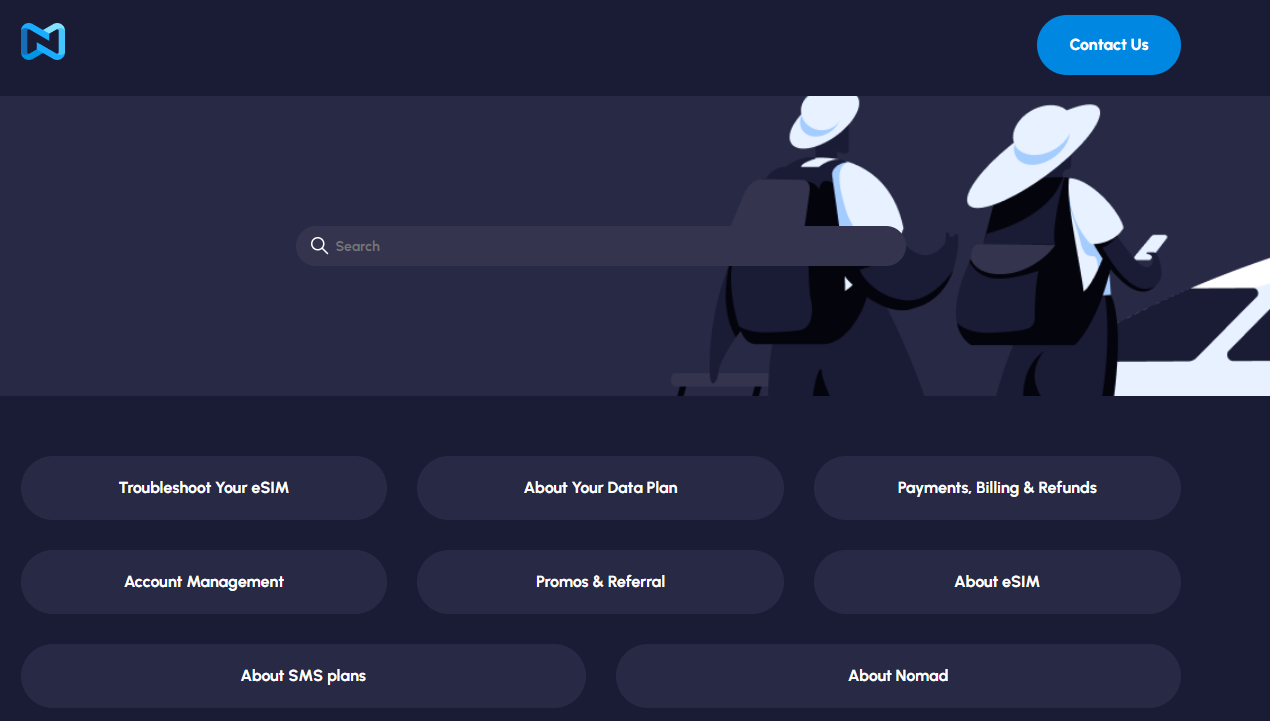
Most of what you’d need help with is already answered in Nomad’s help center, which covers the full setup journey through visual guides, step-by-step articles, and a searchable FAQ spanning everything from installation to billing.
Support runs through a ticketing system powered by Intercom, accessible from both the website and the app, across more than eight help categories covering troubleshooting, billing, account management, and general eSIM questions.
While there’s no phone line, the help center offers over 100 articles that effectively address a range of traveler issues.
Response times are fast, even on weekends, and the 24/7 availability across time zones is not just a claim on the website. If something does go wrong, support is typically the part of the experience that holds up.
Nomad: Final verdict
Nomad is a solid contender for anyone who travels internationally more than a couple of times a year and wants connectivity sorted before they leave home, rather than figured out on arrival. It is not the cheapest option for every destination, and if you are heading somewhere, a local SIM is easy to grab at the airport; it may not need to be your first call.
For multi-country trips, frequent Europe travel, or simply not wanting to think about connectivity at all, it is worth considering. The product works without requiring you to understand mobile networks to use it, and that straightforwardness is genuinely harder to find than it should be.
Nomad: FAQs
Is Nomad eSIM good for the USA?
Yes, and specifically because of the network coverage. Standard Nomad US plans run on the AT&T and Verizon networks, which gives you strong reach not just in cities but on highways and in rural areas too. Unlimited plans switch to T-Mobile’s network instead. The US eSIM supports 4G/LTE and 5G speeds depending on your location, and plans start from $2.20/GB under the North America bundle.
Is Nomad better than Airalo?
Nomad and Airalo both offer plans across a wide range of countries, and the honest answer is that neither is universally better: the right choice depends on your specific destination and data needs. Nomad tends to offer more flexibility in plan sizes, and its per-GB rates in Europe are particularly competitive.
The price gap between the two is usually small enough that support quality and app experience become the deciding factors, and Nomad holds up well on both fronts.
Is Nomad eSIM secure?
Yes. Nomad eSIM is built on GSMA-approved security protocols, the same standards used by major global carriers. When you activate your eSIM by scanning a QR code, the profile is encrypted end-to-end and bound directly to your device. It cannot be removed, copied, or transferred to another phone, which makes it significantly more secure than a physical SIM card that can be cloned or swapped.
Nomad also follows PCI DSS standards for payment processing and does not sell or share your personal data. The one-time QR code used during installation is protected against reuse or interception.
What happens if my phone with Nomad eSIM is stolen?
Contact Nomad’s support team immediately. Because your eSIM is locked to your specific device, a thief cannot extract it and use it in another phone. Nomad’s support team can help you secure your account and deactivate any active plans remotely.
To reduce risk before anything happens, it is worth enabling device-level protections like a passcode, Face ID, or Touch ID, and keeping your account credentials unique and strong. Two-factor authentication on your Nomad account adds another layer of protection worth switching on.
Who is behind Nomad eSIM?
Nomad eSIM is a business line of LotusFlare, Inc., a telecommunications infrastructure software company headquartered in Santa Clara, California. Nomad was launched in 2020 with a mission to make international travel connectivity easy and affordable for everyone. The full eSIM platform is built on LotusFlare’s DNO Cloud.
“}]]
 Nomad is one of the best global eSIMs, offering customizable plans that enable users to bundle together different countries within the same package Read More Latest from TechRadar US in Reviews