
[[{“value”:”
A year and a half after its rebranding, Decodo (formerly Smartproxy) ranks near the very top in our books thanks to its automation-friendly workflows and more than 125 million IPs across 195 locations.
With the public data access platform (as Decodo labels itself), users gain access to residential (dynamic and static), data center, and mobile proxies to level up their browsing security. There’s also a handy Site Unblocker feature that facilitates bypassing CAPTCHA and IP bans, and enables entry to restricted sites.
Besides the ethically sourced proxy pool, Decodo offers APIs for scraping, providing users with a wide array of options to automate the extraction of publicly available information from websites. These include several types of APIs for different levels of expertise and various objectives.
Plans and pricing
Decodo’s pricing is based on how many IPs you require, the volume of traffic, the type of IPs, and the volume of requests. At first glance, the pricing structure is complex, though the gist of it is that it scales directly with your data consumption. So, the more bandwidth or IPs you buy, the cheaper your rate becomes.
Decodo promotes its residential IPs starting from $2 per GB per month under enterprise pricing (excludes individuals and small businesses). However, you need to take the 1000 GB plan, which means you’ll be charged $2000 per month plus VAT (all the prices are VAT-less).
For $150 per month, you get 50 GB ($3 per GB) of traffic for residential IPs; $275 monthly equals 100 GB ($2.75 per GB), while you’d need to set aside $11.25 each month if you want 3 GB ($3.75 per GB) of traffic for the lowest plan.
Static residential proxies, priced by the number of IPs, monthly traffic, or the number of dedicated IPs required, start from $0.27 monthly per IP (that’s if you require 8,000 IPs and 50 GB of traffic). Furthermore, 500 IPs cost $165 monthly ($0.33 per IP), but 10 IPs cost $4.7 (that’s $0.47 per IP). In other words, the greater the number of IPs, the lower the unit cost of each IP.
The pricing for mobile proxies begins at $4.50 per IP with the 500 GB plan, and the price goes up per IP with the lower traffic requirement. Similar to static proxies, datacenter plans are also offered on a GB, IP, and dedicated IP basis. They start at $3,800 for the 10,000 GB plan, or $0.026 per IP if you go with the 4,000 IP option.
If you decide to go with the pay-as-you-go option for residential proxies, it’s priced by 1 GB, each costing $4. For mobile proxies, the price is $8 per 1 GB, while the static dedicated ISP and datacenter proxies don’t have the pay-as-you-go option available.
There’s a 14-day money-back guarantee if you’re not entirely satisfied with the service, although it’s not offered for every pricing plan. That said, you can first take it out for a spin during the rather short three-day free trial with 100MB of traffic before making a final decision.
All things considered, Decodo runs a pricing model that favors bulk users over individual ones and small businesses. So, if you run a large organization that needs many IPs and gigabytes, you’ll find the platform cost-effective due to the significant discounts. Otherwise, it might be expensive.
Features
Of course, registration is the first step, which you can complete with an email address, a Google account, or a GitHub account. Your account dashboard conveniently has all features located on the left, which you can easily sift through. Whether you need residential proxies, ISP proxies, or scraping, you can select the option on the left menu.
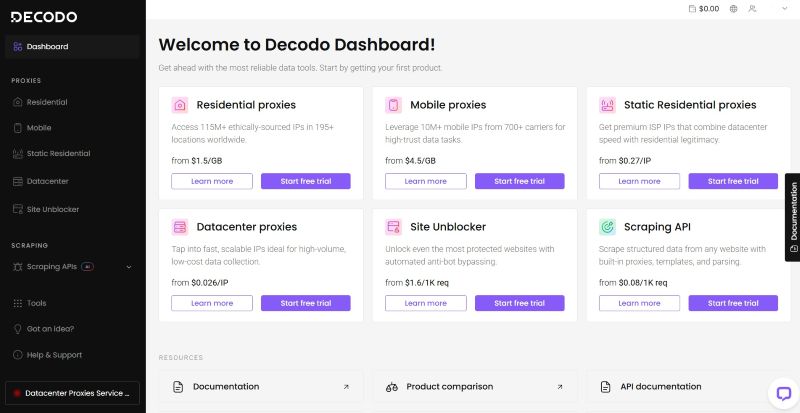
Once you settle on a plan, you can add users either as proxy users or team members. And with administrative privileges, Decodo provides you with full control over the IP resources you’ll allocate to each proxy user. For example, you can give a user 1 GB of data and another 10 GB. Each user from your organization has unique credentials to access Decodo.
You can create and customize proxy connections from your dashboard. Your first order of business will be to choose a sticky or rotating proxy. Sticky proxies change at set intervals (up to 24 hours), while rotating proxies change with every connection request. Then, you can choose an IP from a specific country/city or a random one as your proxy. With these options set, you can start utilizing Decodo’s online protection.
Let’s dive deeper into the features of this app:
Residential proxies
Residential proxies route your web requests through real home internet connections rather than anonymous server hubs. This setup is ideal for evading localized geo-blocks or checking out regional search results.
Decodo heavily emphasizes that its proxy fleet is entirely “ethically sourced,” meaning home users explicitly consent and are compensated for sharing their bandwidth. You can target traffic across 195+ global locations, with the largest concentration of active nodes located in India, the US, Germany, and the UK.
Our testing confirmed that their residential pool boasts exceptional connection uptime and swift, hitch-free speeds.
Static residential (ISP) proxies
Combining the speed of a datacenter proxy with the legitimacy of a home connection, static residential proxies solve the issue of long web automation sequences or managing multiple social media accounts. Whereas standard rotating IPs would get you flagged, Decodo’s ISP proxies from premium internet service providers like AT&T, Verizon, Orange, and Tele2 lower block rates via permanent IPs.
They deliver an impressive 99.99% uptime, latency reaction times under 0.2 seconds, and full HTTP(S) / SOCKS5 protocol integration. Decodo offers them as shared ISP proxies for flexible scaling and dedicated ISP proxies for an exclusive single-user IP per project.
Mobile proxies
To mimic smartphone traffic, Decodo gives you access to a dedicated (and ethically sourced) mobile proxy pool of over 10 million real 4G/5G mobile carrier IPs covering 160+ locations and 700+ network providers. The bulk of this mobile network is concentrated across the United States (3.9 million IPs), Germany (1.2 million), the UK (940,000), and India (720,000).
Mobile proxies are highly resilient against blocks because web platforms are naturally hesitant to ban cellular IPs, which frequently rotate among hundreds of real users. Decodo boasts a 99.75% success rate with its mobile proxies, which makes them a key asset for mobile application testing, localized ad verification, bypassing content geo-restrictions, and heavy web scraping.
Datacenter proxies
When sheer speed and high-bandwidth processing matter more than stealth, Decodo’s datacenter proxies are a good bet. These are offered as shared versions (aimed at projects with tight budgets for data collection) and dedicated versions (exclusive IPs for consistent identity), and count half a million IPs with a
While Decodo’s shared datacenter servers span a wide array of global regions, its 100% dedicated datacenter servers remain strictly limited to US locations. For those engaging in data-driven scaling, the platform supplies real-time stats to keep track of your effort.
Site Unblocker
Described by Decodo as a proxy-like solution, Site Unblocker is an advanced web extraction tool built to act as an all-in-one scraper. Instead of writing complex custom scripts to manage connection retries or bypass security walls, the Site Unblocker automates the hard work.
It uses browser fingerprinting to forge unique browser identities for each request and handles dynamic JavaScript rendering without requiring resource-heavy headless browsers. The tool also features automated IP rotation to make sure you bypass target anti-bot blocks.
Scraping
Arguably, the biggest advantage of having Decodo in your software lineup is its automation-oriented approach. The service provides APIs and scraping templates that let you automate website data collection instead of doing it manually by yourself for every site.
This includes search engine results pages (SERPs) like Google (fully updated to cleanly parse the latest AI Overviews layouts), eCommerce websites, and social media. As of late, you can also effortlessly extract real-time responses from public AI tools, as well as YouTube video transcripts and channel metadata.
All of the above fall under the umbrella of Web Scraping API. It automatically handles all the infrastructure knicks and knacks, from IP switching to CAPTCHA bypassing, courtesy of machine-learning fingerprint rotation. It uses a flexible credit system to keep costs optimized, as developers can configure request complexity on the fly. That way, teams only pay for advanced residential pools and scraping power when targeting a highly locked-down website.
Beyond traditional HTML and JSON payloads, the API delivers diverse data outputs like screenshots, tables, CSVs, XHR, and clean Markdown tailored specifically for AI integrations.
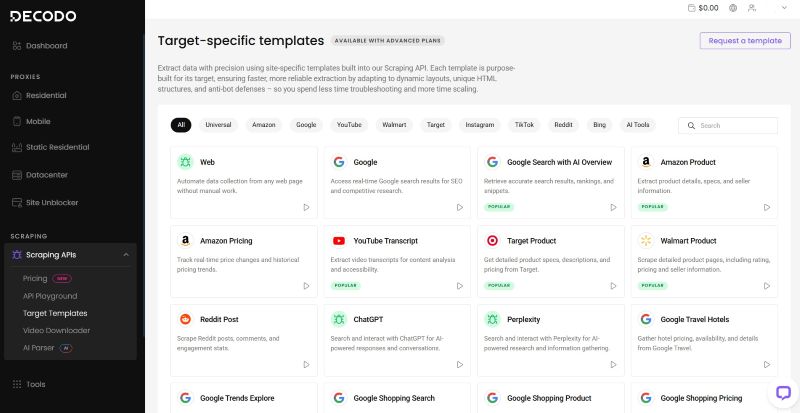
When it comes to social media scraping, users can choose between real-time synchronous queries or asynchronous callbacks, paying exclusively for successful results via automated retries. The API does a commendable job of transforming dynamic social streams into cleanly parsed, structured JSON or HTML payloads.
For instance, you’ll be able to track the engagement rates of influencers working with your brand, monitor your competitors’ follower numbers, or discover trending content in real time or at a specific time. The YouTube scraping engine allows efficient extraction of raw video transcripts, backend schema metadata, and engagement metrics without getting throttled.
Those eyeing eCommerce scraping will get the option to extract product data from over 50 major marketplaces, including Amazon, Walmart, and eBay. Doing so allows businesses to securely pull real-time data on pricing, full product listings, images, and customer reviews.
Developers can instantly deploy over 100 ready-made scraping templates to monitor dynamic pricing shifts, track localized stock levels, detect counterfeit items, or aggregate clean AI training datasets. Scraping tasks can be scheduled in advance, and you’ll receive an email notification once they’re done.
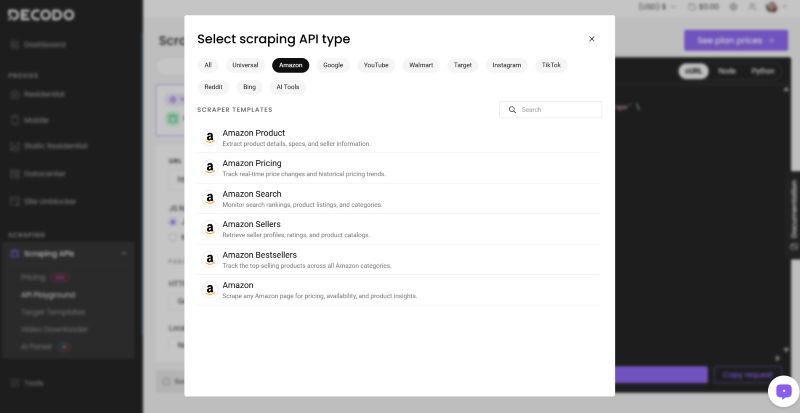
Last but not least, the SERP scraping API provides an automated pipeline designed specifically to extract structured data from major search engines like Google, Bing, Yahoo, and Baidu. This allows businesses to scrape localized search engine results pages down to the city or zip-code level with 100% successful data delivery guaranteed through automated retries.
AI workflows
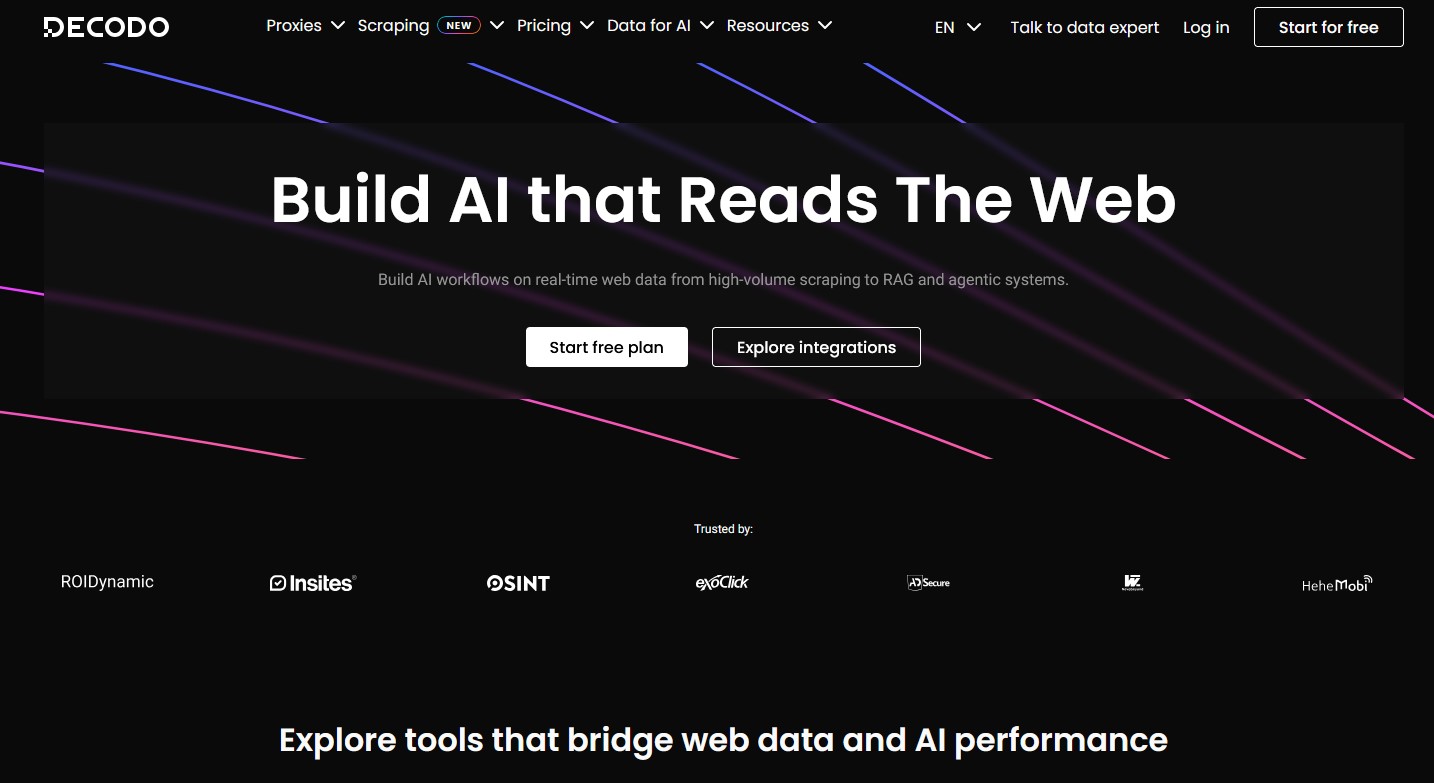
Decodo recently introduced a free, prompt-based AI Parser alongside a rapid Fast Search API. The system uses simple, natural language prompts to instantly translate unstructured web data into clean JSON or LLM-friendly markdown. This native formatting greatly contributes to development speed, as it strips out layout noise and drastically lowers token consumption when feeding live web data directly into an AI context window.
The ultimate evolution here is Decodo’s transition into an autonomous data-enablement platform natively integrated with AI ecosystems like LangChain, n8n, and the Model Context Protocol (MCP). For example, by supporting an MCP server, Decodo enables AI agents running inside environments like Claude or ChatGPT to autonomously navigate the web, switch proxy nodes, and handle scraping blocks completely on their own via natural language commands
Ease of Use
Decodo’s user interface is easy to navigate. On the desktop, all features are arranged on the left side, and you can easily access your desired feature with a single click. With a white background, black text, and colorful buttons, the whole setup is pleasing to the eye.
Along with the website interface, Decodo offers a Proxy Checker that lets you test up to 10,000 proxies after uploading them with one click.
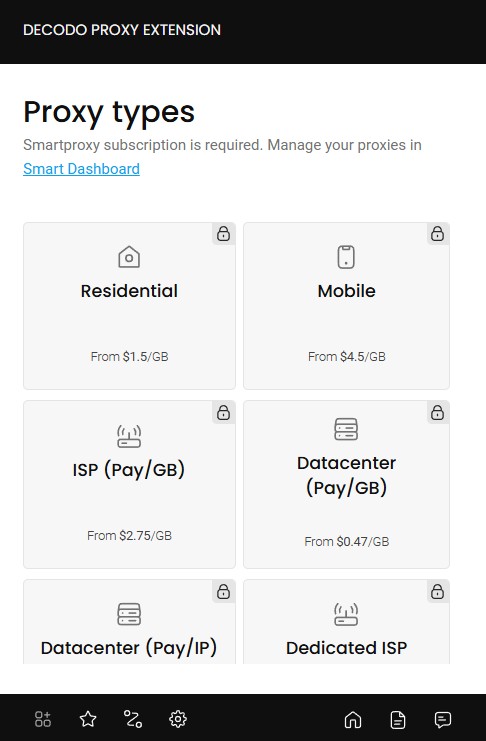
There are also browser extensions for Google Chrome and Firefox, which give you access to features like one-click IP rotation, customizable session length, and seamless switching between proxies. Additionally, they include WebRTC Leak Prevent to stop WebRTC from bypassing your proxy, masking both your real IP address and location.
Like the main Decodo interface, the extensions are easy to navigate.
Decodo makes it easy to integrate its proxies with various third-party tools, such as eCommerce purchase bots, scraping software, SEO tools, and external proxy managers like MuLogin and AdsPower. The backend is all covered, so you just need to carry out a few steps to kickstart the integration from the intuitive dashboard.
Customer Support
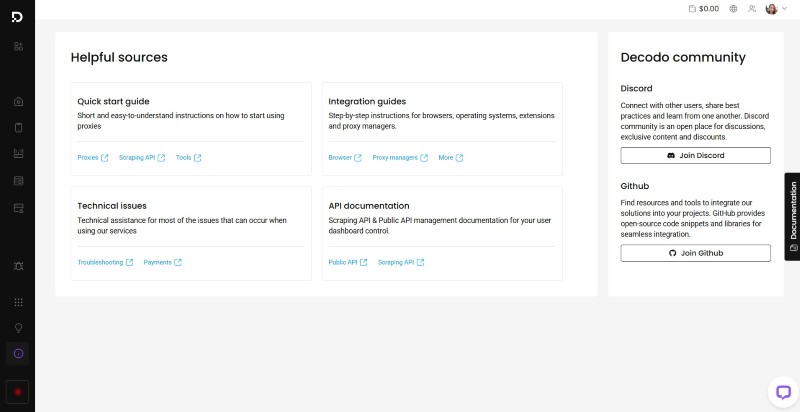
Excellent customer support is one of Decodo’s strengths. This support begins with extensive technical documentation for its features. You can find tutorials and user guides concerning all features, with detailed screenshots illustrating the instructions. You can learn everything about the app in the Help Center, from a basic introduction until you reach more complex aspects.
Decodo has a YouTube channel with video tutorials about its features. This channel allows users to learn about the platform more interactively and has dozens of illustrative and engaging videos.
Of course, customer support can’t be left to the customer alone. If you need help, Decodo’s support team is available via live chat. You can contact the support team 24/7 and get speedy answers, although the response time varies depending on your time zone. You can also reach Decodo’s support team via email (for non-urgent inquiries) and expect a response within 24 to 48 hours.
Other complementary support resources include Decodo’s GitHub repository with code samples and a Discord channel where you can connect with other users and share solutions to common issues. Decodo also holds frequent webinars to help users learn the ins and outs of this platform and general trends in the proxy software market.
The Competition
There’s no shortage of competition in the proxy software sector. Decodo has robust competitors like IPRoyal, OxyLabs, and WebShare. It outshines many competitors by providing a broader range of global IP addresses and complementary features like the AI workflows and scraping APIs. However, our main issue is with Decodo’s pricing– it’s significantly more expensive than many rivals, especially for low-volume users.
If you’re a bulk user needing hundreds of proxy IPs, Decodo is an ideal tool. However, it’s too costly for individuals or small enterprises needing a few dozen IPs at most.
Final verdict
There are solid reasons why Decodo gets tagged as one of the better proxy networks in the game. It’s fast and reliable, offers a rather sizable IP pool, and the dashboard is clean enough that you won’t pull your hair out setting it up. Plus, the company throws in a ton of great built-in tools to help you smash through aggressive anti-bot blocks and handle heavy scraping workflows.
The only real catch is Decodo’s focus on bigger dev teams and enterprise-level scaling. In case you’re running a small operation or just tinkering with a solo project, some of the price tags will likely make you flinch.
We’ve also highlighted the best proxy and best VPN
“}]]
 Decodo is a proxy platform that offers a wide range of features and very competitive pricing. Read More Latest from TechRadar US in Reviews