
Post Contenthttps://www.youtube.com/shorts/aW2JgTeffno
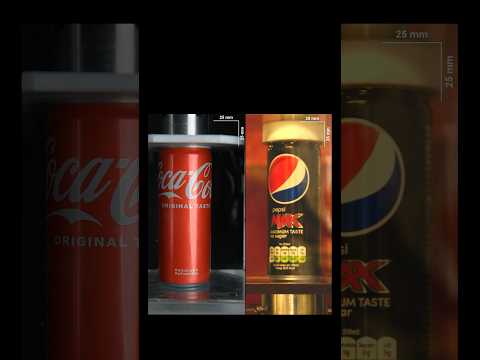 [[{“value”:”A soda can sits below a descending mechanical arm, and within seconds, roughly 250 kilograms of force—the weight of a grizzly bear—will decide its fate. Slow the footage down frame by frame, though, and the destruction turns out to be surprisingly orderly. Rather than crumpling all at once, the can develops a single ridge around its waist, which stabilizes before a sequence of rings appears beside it. What was once a smooth surface gradually transforms into a corrugated pipe before it finally bursts. Physicists have now explained what drives that sequence.
To catch what the naked eye misses, the team compressed liquid-filled aluminum beverage cans in a laboratory press, filming the carnage at 25 frames per second. The researchers found that the material behavior of the aluminum can itself drives the orderly collapse. As the metal bends outward into a ridge, it briefly softens, becoming easier to deform. But before that ridge can grow too deep, the material restiffens, making it energetically cheaper to start a fresh ring next door than to keep deepening the old one. Mathematicians call this process homoclinic snaking—a snakes-and-ladders dynamic in which the system climbs toward a new stable state, slides back, and spawns a neighboring ridge instead of catastrophically collapsing.
The results provide the first solid experimental confirmation of a mechanism mathematicians had theorized for roughly 25 years but had not seen demonstrated in a physical material.
Learn more: scim.ag/4gprIEl
FOOTAGE CREDIT: JAIN ET AL./COMMUNICATIONS PHYSICS
#Physics #Science #ScienceShorts”}]] Read More Science Magazine
#Science
#sciencechannel
#sciencemagazine