
[[{“value”:”
Hisense UR9 RGB MiniLED TV: Two-minute review
The Hisense UR9 is a great showcase for all that RGB LED TVs have to offer. The RGB LED tech in this TV means its able to hit a much wider range of colors than rival mini-LED TVs with more brightness.
Thanks to the fact this TV gets up to 180Hz refresh rate helps it compete with the best gaming TVs out there (as do features like AMD Freesync). And the color coverage and accuracy are as good as anything else you’ll find on the market.
Of course, an RGB TV like this does suffer from some minor blooming, which the best TVs in the premium mid-range bracket have mostly solved. Add in the higher price tag and it’s clear that the Hisense UR9, as well as the other RGB LED TVs hitting the market, don’t offer up the same value as other QLED or mini-LED TVs in the same price range.
Like those other TVs though, it is filled to the gills with features, such as the conversational, AI-powered (albeit imperfect) Google Gemini voice assistant. Dolby Vision 2, Dolby Atmos, and other AI-powered features are also on offer.
The whole package is a bit pricey (unless you get one through Best Buy where the price has been slashed by a significant amount), but if you’re willing to throw in extra cash to be an early adopter, the Hisense UR9 is a great centerpiece to a home theater.
Hisense UR9 RGB MiniLED TV review: Price and release date
- Release date? April 2026
- 65-inch: $3,499.99 ($1,999 through Best Buy), £1,699, AU$2,995
- 75-inch: $4,999.99 ($2,999 through Best Buy), £2,299, AU$3,995
- 85-inch: $5,999.99 ($3,999 through Best Buy), £2,999, AU$4,995
- 100-inch: $8,999.99 ($5,999.99 through Best Buy) (around £6,760 / AU$12,780)
Since RGB LED TVs are the newest technology on the block, the prices are going to be a little higher than if you compare to more standard mini- or micro-LED TVs. After all, these types of TVs have only been on our collective radar since they were first introduced at CES 2025.
The Hisense UR9, released in April of 2026, has an MSRP of $3,499.99 / £1,999 / $3,999 at its smallest 65-inch size with prices going up to $8,999.99 (around £6,760 / AU$12,780) for the 100-inch, the biggest in the product line — although this size is only available in the US. It’s also available in 75- and 85-inch sizes.
Of course, the price has dropped since its release at various retailers by a pretty significant amount, with prices of $1,699 / £1,699 / AU$2,995 for the 65-inch, $2,499 / £2,299 / AU$3,995 for the 75-inch, and $3,499 / £2,999 / AU$4,995 for the 85-inch. Finally, the 100-inch version has had a massive price drop in the US down to $4,999.99 (around £4,510 / AU$8,520).
Hisense UR9 RGB MiniLED TV review: Specs
|
Screen type |
RGB mini-LED |
|
Refresh rate |
180Hz |
|
HDR support |
HDR10, HDR10+, HLG, Dolby Vision |
|
Smart TV |
Google TV |
|
HDMI ports |
3x HDMI 2.1 (1x eArc), DisplayPort |
|
Built-in tuner |
ATSC 3.0 (NextGen TV), NTSC, Clear QAM |
Hisense UR9 RGB MiniLED TV review: Benchmark results
Brightness measurements
| Product | HDR Filmmaker Mode (10% window) (nits) | HDR Filmmaker Mode (Fullscreen) (nits) |
|---|---|---|
| Hisense UR9 | 4370 | 1096 |
| TCL QM8L | 3719 | 759 |
| Hisense UR8 | 2097 | 771 |
| Product | HDR Standard Mode (10% window) (nits) | HDR Standard Mode (Fullscreen) (nits) |
|---|---|---|
| Hisense UR9 | 3003 | 1124 |
| TCL QM8L | 3771 | 795 |
| Hisense UR8 | 2394 | 767 |
| Product | SDR Filmmaker Mode (10% window) (nits) | SDR Filmmaker Mode (Fullscreen) (nits) |
|---|---|---|
| Hisense UR9 | 188 | 227 |
| TCL QM8L | 229 | N/A |
| Hisense UR8 | 314 | 372 |
| Product | SDR Standard Mode (10% window) (nits) | SDR Standard Mode (Fullscreen) (nits) |
|---|---|---|
| Hisense UR9 | 2175 | 794 |
| TCL QM8L | 518 | N/A |
| Hisense UR8 | 1514 | 778 |

HDR color gamut
Closer to 100% is better. Taken using a colorimeter and test pattern generator.
| Product | UHDA-P3 () | BT.2020 () |
|---|---|---|
| Hisense UR9 | 99.8 | 93.1 |
| TCL QM8L | 97.9 | 90.3 |
| Hisense UR8 | 145 | 95.1 |
Picture accuracy
A lower score is better. Taken using a colorimeter and test pattern generator.
SDR Delta-E
| Product | Value |
|---|---|
| Hisense UR9 | 2.7 |
| TCL QM8L | 3.7 |
| Hisense UR8 | 7.9 |
Input lag
Lower is better. Taken using a Leo Bodnar 4K HDMI Video Signal Lag Tester.
4K 60Hz
| Product | Value |
|---|---|
| Hisense UR9 | 12 |
| TCL QM8L | 9.5 |
| Hisense UR8 | 11.7 |
Hisense UR9 RGB MiniLED TV review: Features
- Comes with updated Dolby Vision 2
- Google Gemini is conversational if slightly inaccurate
- Comes with other AI-powered features including screensavers
Considering the price of the Hisense UR9, it’s no surprise that it has the smorgasbord of features one would expect. It comes with Dolby Vision IQ, which changes the picture based on ambient light. It also comes with Dolby Vision 2, the newly updated format that optimizes HDR content on a picture-by-picture basis using dynamic metadata. And, of course, the various HDR formats (HDR10, HDR10+ Adaptive, HLG) are all here as well. Internet connectivity is pretty fast too, thanks to Wi-Fi 6E.
This TV works with Apple HomeKit, Amazon Alexa, and has Google Cast and Google Assistant built in. And since there’s also far-field voice control on offer, you can basically interact with the TV to a large degree without a remote.
This particular feature runs through Google Gemini, Google’s AI-powered voice assistant. There are quite a few things I like about this voice assistant. Its conversational style, not to mention the various timbres to choose from, make it a more familiar experience (unless the uncanny valley-ness of it all is something that tends to get to you). I can ask it all sorts of things outside of controlling the TV, which is nice as well.
However, like my other experiences with Google Gemini, it’s not as accurate as one would hope, making it an imperfect companion for hands-free control, whether that means giving incorrect information about where something is streaming, or just posting up a bunch of YouTube videos about my requests instead of following through on my requests, which tend to be along the lines of: “Hey Google, play [insert content] on [streaming platform].”
Like other 2026 (and late 2025) TVs that I’ve interacted with, AI is the predominant buzzword that ties them altogether. It’s part of Google Gemini. It’s part of the RGB chipset. And it’s part of various other behind-the-scenes settings on the TV. Besides Google Gemini, the other user-facing feature utilizing AI is the screensaver where you can use either a photo from your Google account, artwork, or create AI artwork — a fun if, in my opinion, somewhat inconsequential feature.
- Features score: 4.5/5
Hisense UR9 RGB MiniLED TV review: Picture quality
- Impressive BT.2020 coverage and color accuracy
- Plenty of brightness on tap
- Some slight blooming
On paper, RGB mini-LED TVs (or MicroRGB for certain brands) should be a game changer for picture quality. In practice, I wouldn’t say it’s quite that, but it is a vibrant and immersive screen that’s mostly a pleasure to use.
Looking at benchmarks, it is impressive with an almost 100% UHDA-P3 and over 92% BT.2020 color coverage in filmmaker mode — the fantastic TCL QM8L I recently reviewed hit 87% BT.2020 (both TVs are advertised as hitting 100%, of course).
The color accuracy in filmmaker mode is also a fairly impressive Delta E > 2.2 (closer to 0 is better), though it shoots up to 9.9 in standard mode. Changing into filmmaker mode on any TV greatly affects the colors shown onscreen, but it’s never been so noticeable as it is on this TV.
Just like other more premium 2026 options, the brightness is more than enough. In our benchmarks, we recorded 227 nits in filmmaker mode and almost 800 in standard. And in our luminance benchmarks, it reached 4370 nits for 10% window and almost 1,100 in full screen for filmmaker mode.
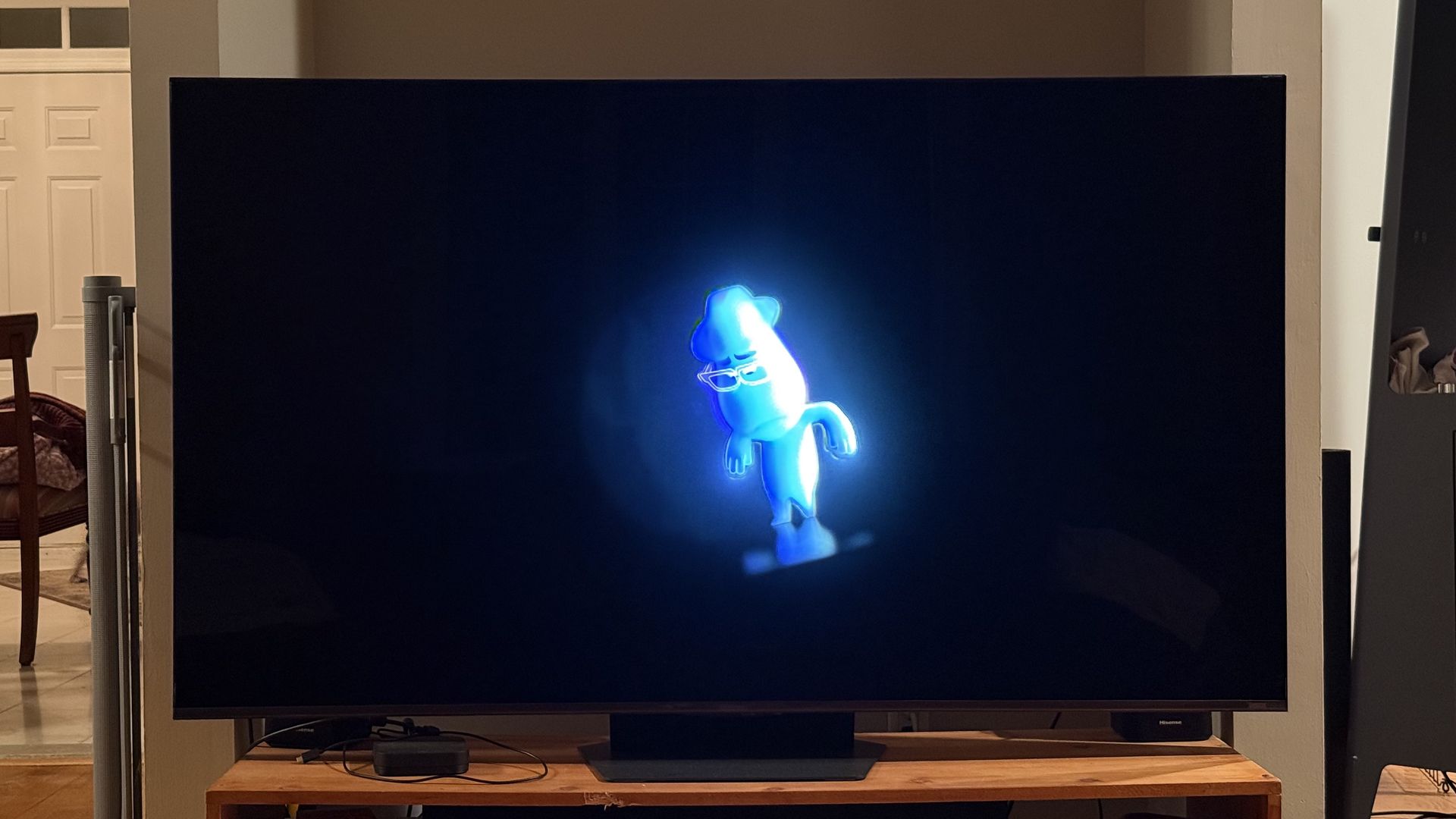
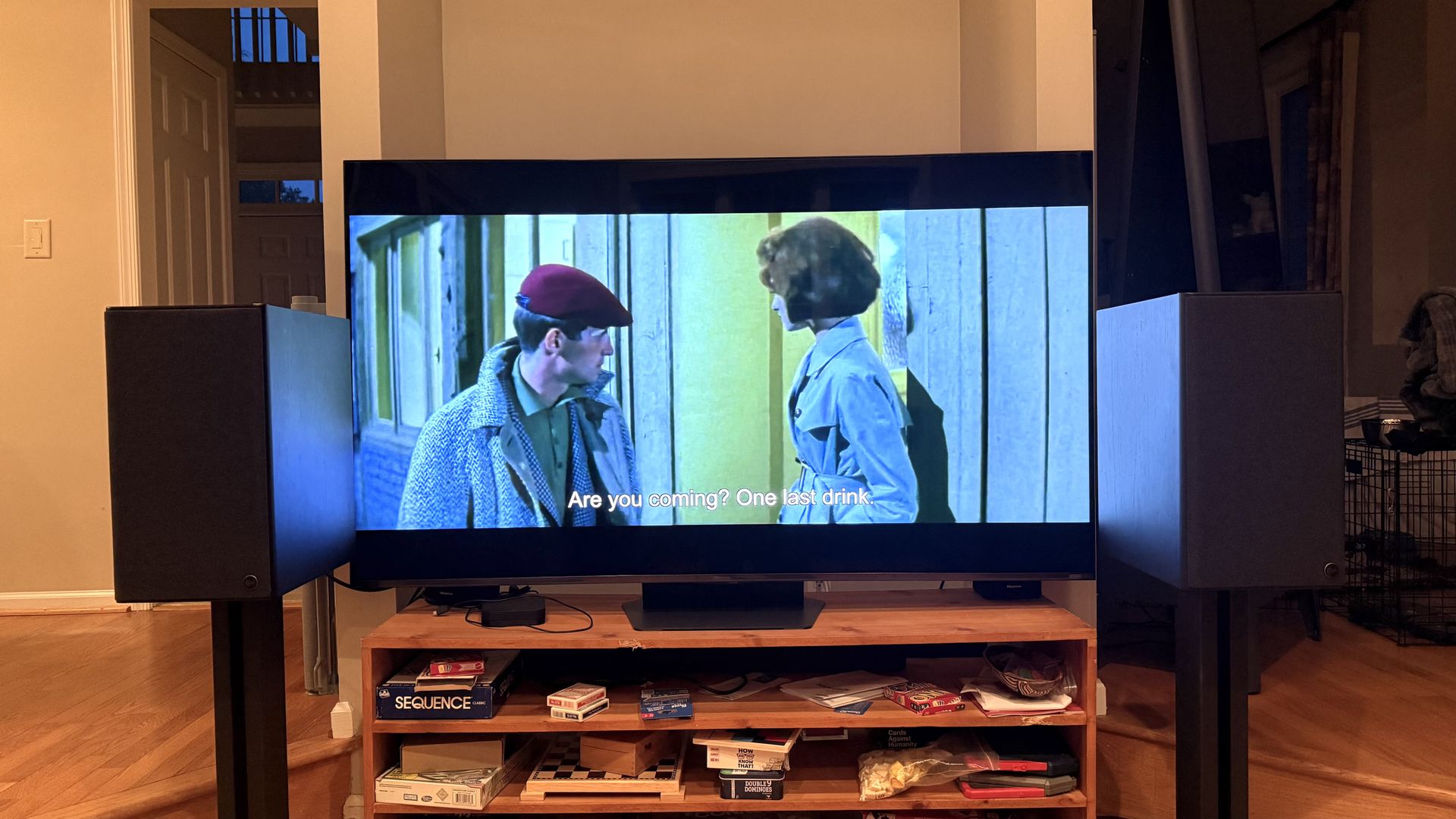
I actually found the screen almost too bright. One of the reasons I like using filmmaker mode, especially on TV is the much reduced brightness. Of course, it still retains all the detail, whether it’s the individual floorboards on a basketball court or the individual stars in the vastness of afterlife space per the movie Soul.
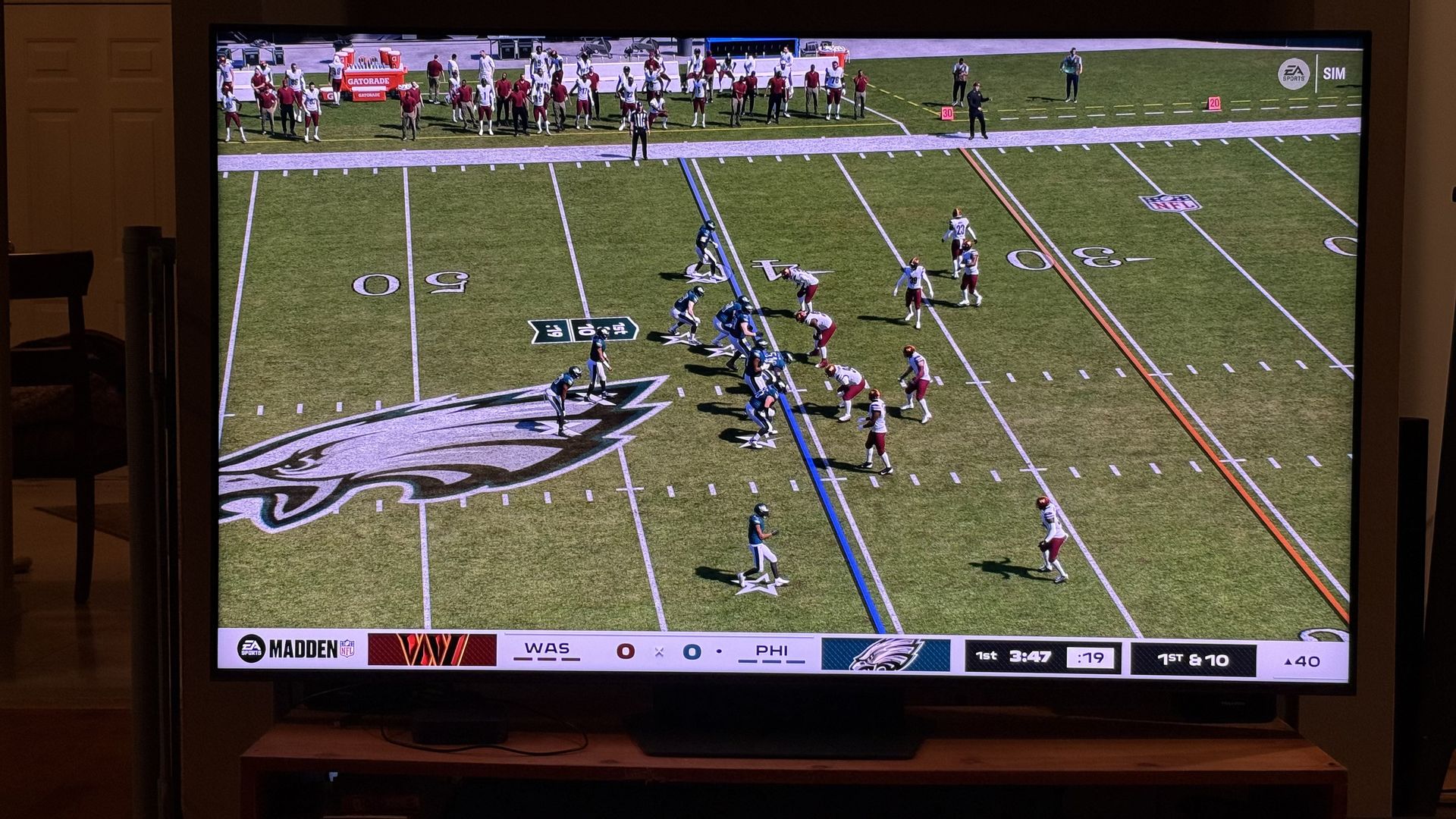
The picture is also smooth without any judder when there’s a lot of action, whether I’m watching some sports, movies, or even video games. For instance, watching the Detroit Pistons attempt a playoff comeback was as engaging as could be. I could keep track of not only the ball, but all the players whether they’re running a pick and roll or grabbing a rebound.
Funnily enough, that is without all the AI clarity-related features. AI Super Resolution does sharpen things up a little, though I could see the AI in the player’s faces at the highest settings. The Motion Enhancement smooths out the action a bit, which I found unnecessary, while the Motion Clearness sacrifices some of the picture fidelity for keeping up with the action. Also unnecessary with this TV.
However, when using those features for older content — say old, forgotten videos from the early days of YouTube — they do a decent job upscaling grainier content into something a little more pleasant and updated looking. While I wouldn’t say older content looks 4K, it does look cleaner, sharper, and with better color.
The lone issue I found with the image quality is that it’s not as good at controlling blooming (also known as the Halo effect) due to the way RGB LEDs work. Since the red, blue, and yellow LEDs sit right next to each other, there’s more opportunity for cross talk between pixels than other TVs of similar quality that use a single LED in the same place with a filter creating the color.
I pulled up the usual screen tests on YouTube and didn’t really notice this too much as the image was sharp and clean. However, when watching Disney’s Soul, I noticed that when the main character enters the afterlife for the first time and is now a glowing avatar instead of a human in a void, he has a glow around him. Now, that’s somewhat intentional but it’s more muted on the other TVs I have accessible to me for comparison (the TCL QM8L and the Roku Pro Series TVs, specifically). This is, unfortunately, just a current limitation of RGB LED technology.
Back on the positives, the Hisense UR9 offers a number of picture modes including Film Maker Mode and IMAX Enhanced to take advantage of different content, something you don’t find (or at least to the same degree) on cheaper televisions.
- Picture quality score: 4/5
Hisense UR9 RGB MiniLED TV review: Sound quality
- 110W of power with 4.1.2 virtualized spatial audio system
- Sounds good except mids are bit forward
- Room calibration and Intelligent settings help TV sound better
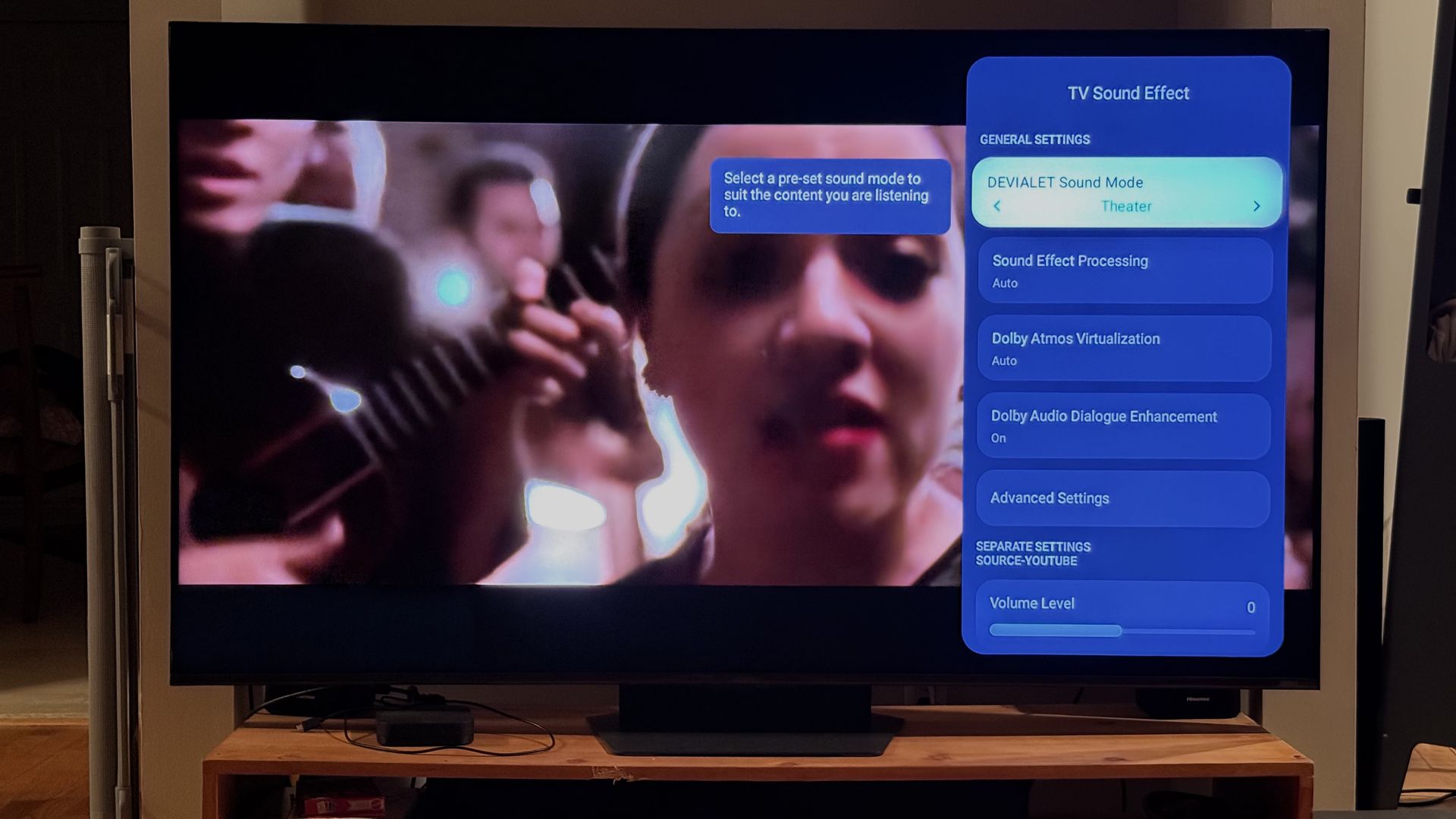
If you’re a TV manufacturer wanting to upgrade the audio experience, having Devialet tune your TV as the company has done with the Hisense UR9 is a good move. And I can confirm that the Hisense UR9 sounds pretty decent on its own.
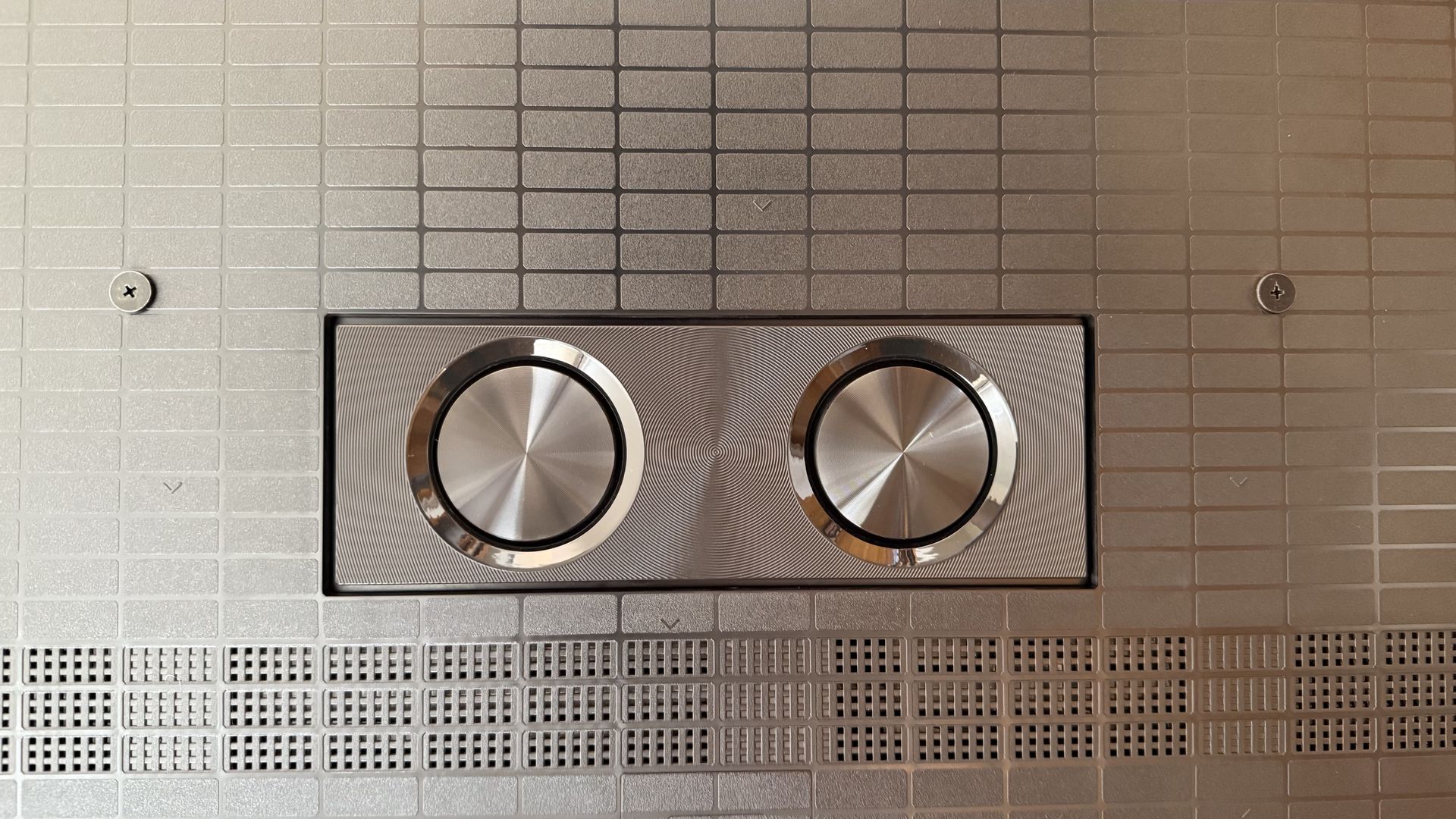
Without an additional soundbar, this TV has up to 110 watts of power and provides a 4.1.2 multi-channel surround experience (6.2.2 channel audio in 100-inch), though you won’t get a full surround sound experience as all the speakers are in the TV, either pointing down or back. And when using Dolby Atmos content, it only produces a virtualized version when just using the TV speakers.
Now, the actual sound quality is good for a TV if not quite amazing. There’s a bit of a peak in the mid-bass on standard mode that gives the audio a bit of a bloated feel. However, this is easily mitigated, either by using the seven-band equalizer hidden in the bowels of the audio settings and pulling the 500Hz slider down a few ticks to taste (I had it at -4). Or if you’re lazy like me, just turn on the Intelligent Sound feature in the Intelligent Settings and it will do it for you.
The bass is decent for a TV without an actual subwoofer, though you’ll want to add one if you want that theater experience. And the high-end is clear and present.
There’s also a room calibration feature that, like the Intelligent Sound feature, will right the audio ship of this TV with minimal effort.
Of course, if you want to really upgrade the audio experience, this TV does pair with the Hisense HT Saturn speakers, which not only provides a surround sound and spatial audio experience, but also has specific features such as Hi-Concerto (using both the speakers of the sound system and the TV in tandem) among others.
- Sound quality score: 4.5/5
Hisense UR9 RGB MiniLED TV review: Design
- Semi-adjustable central stand
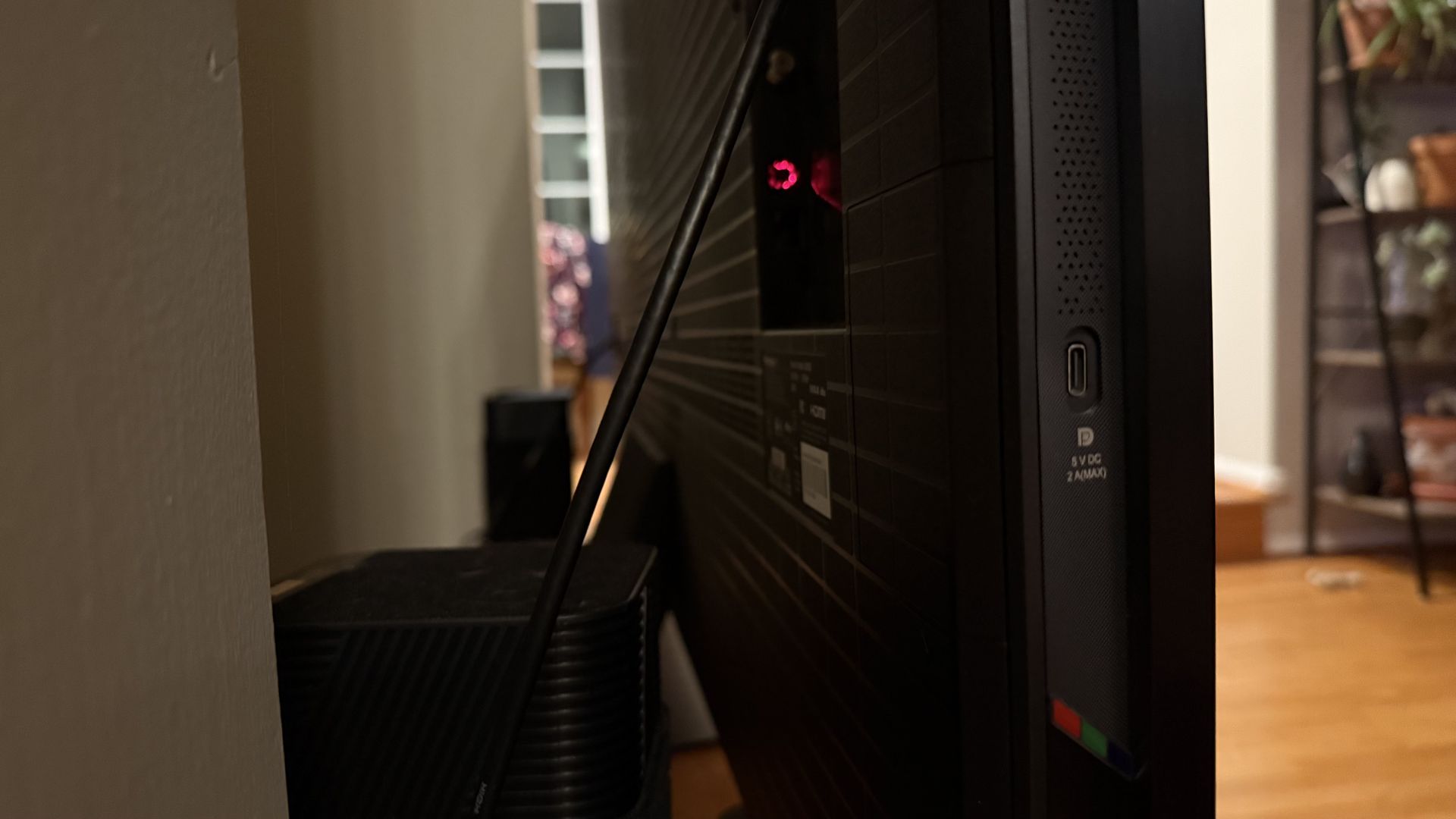
- A little bit on the thick side
- Three HDMI 2.1 and a USB-C port with DisplayPort support
I feel like a broken record sometimes, but I will always tout the benefits of a central stand. So when I unboxed the Hisense UR9 and saw that the base was one central stand instead of legs on the far corners of the panel, I was thankful. I was maybe a little less thankful screwing in the base into the accompanying stand and then the stand into the back of the TV (I did do this alone so it will be significantly easier if you enlist a second person). But I did at least appreciate that the stand can be screwed into four different heights, so you can adjust how high the panel sits off the TV stand.
The panel uses very thin bezels — I feel like that’s more standard than not these days — with the exception of the bottom one that also holds the sensor. A little more unusual is the thickness of this TV. Make no mistake: this is still a flat panel TV, but it is just under two inches thick. Of course, if you’re into mounting your TV, it will sit a little more flush than the typical TV, due to the lack of unsightly bulge on the back.
When I unboxed the Hisense UR9, I was surprised by the fact that it only came with three HDMI ports. However, not only are they of the 2.1 variety so they support 4K at up to 180Hz (great for next-gen consoles that get up to 120 fps), but there’s also a USB-C port with DisplayPort support. That’s great for plugging in a PC for professionals that want to use a TV to work on — although, let’s be real, PC gamers are probably the ones who’ll take most advantage of this.
As far as controls go, there’s just a single button on the bottom of the TV so don’t lose that remote. Thankfully, the fully backlit remote is on the bigger side so it’s not easy to lose. Of course, you can always just talk to the Hisense UR9 using Google Gemini.
- Design score: 5/5
Hisense UR9 RGB MiniLED TV review: Smart TV and menus
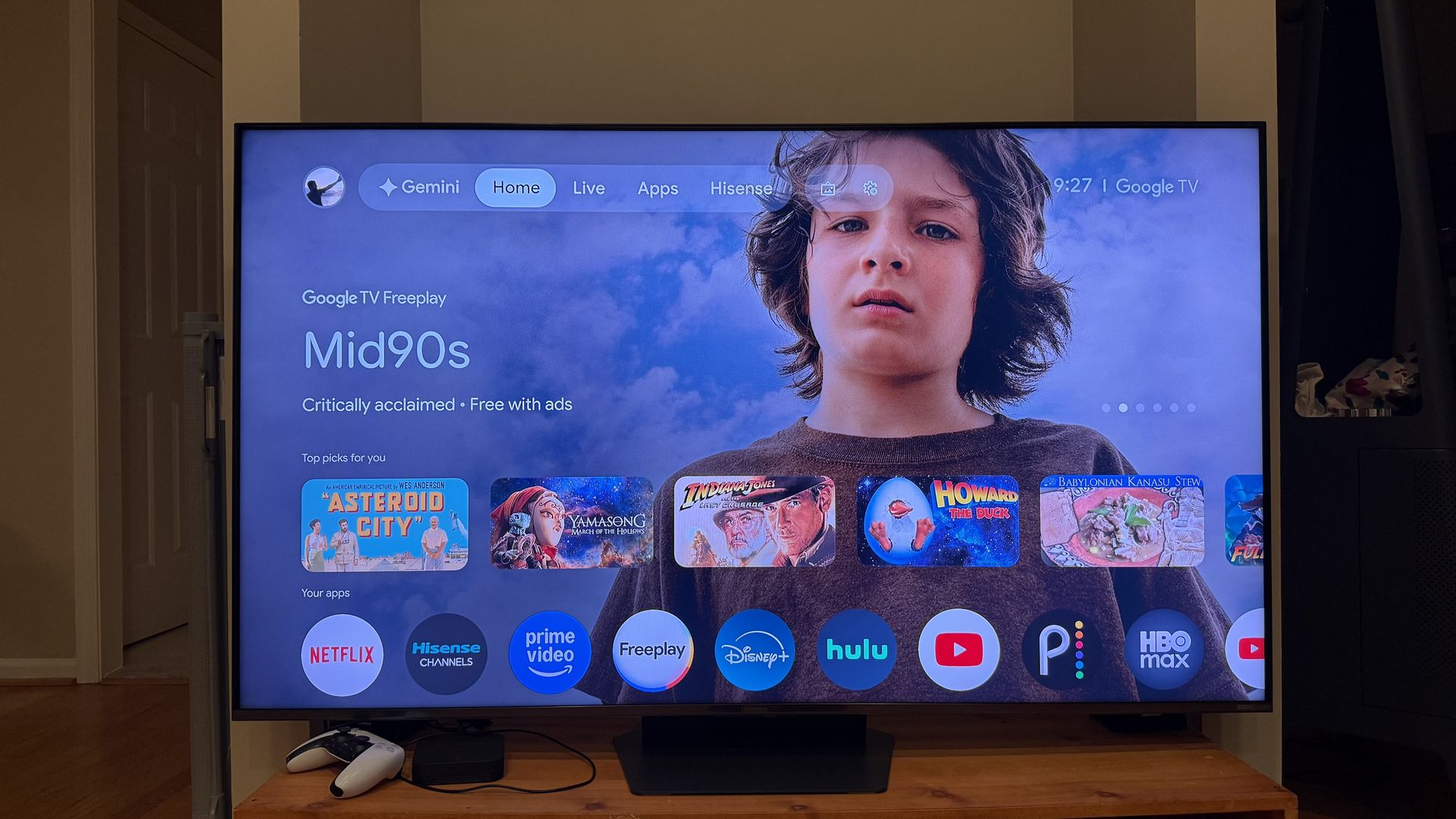
- Google TV interface is intuitive if a bit YouTube-biased
- Settings menus could be a little better organized
- Google Gemini can be used to adjust settings
If the Fire TV interface that Amazon TVs come with seem to focus too much on Prime-related content, then the Google TV interface used here is a little too YouTube happy. But, outside of that bias, the layout of the interface is pretty intuitive for getting to content.
Not only does it feature tailored suggestions in the banner that takes up half of the screen, but it follows it with a row of suggestions across different streaming services as well as a “Continue Watching” row. Of course, the apps are also lined up in a row if you prefer to dig deep that way.
There’s plenty of Google TV-specific content even if you don’t use YouTube, with a good number of free channels playing content in a similar fashion as live cable (or cable-like streaming platforms like YouTube TV).
My only real gripe with Google TV is navigating the settings menu. This is mainly because it does require some digging to get to certain features. For instance, the room correction or calibration feature for audio is not available under audio, but under intelligent settings. While this sort of makes sense, it should also be under the audio settings since any adjustments I make to audio should be available there.
For picture settings, I did appreciate the number of various parameters available for adjusting. I can change the Gamma, for instance, as well as multiple motion blur and smoothing options, to name just a few.
Lastly, I’ve already talked about Google Gemini earlier, but it is a valid way of navigating this TV and its settings. However, besides the other issues I mentioned earlier, for whatever reason it just won’t directly play content from a voice command.
- Smart TV & menus score: 4.5/5
Hisense UR9 RGB MiniLED TV review: Gaming
- Supports 4K at up to 180Hz depending on input
- Plenty of gaming features on offer
- Game Bar requires some menu diving to access
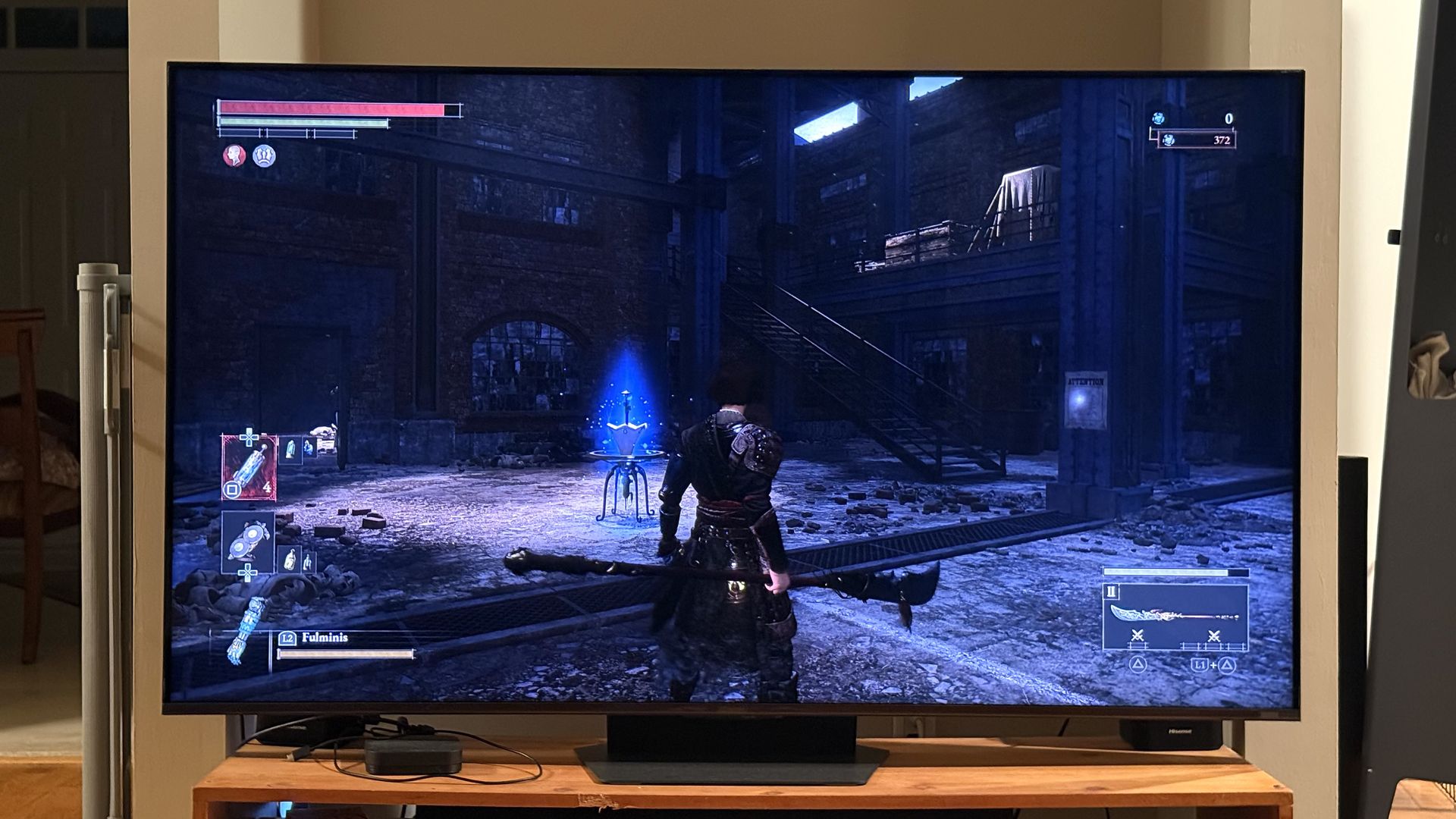
To test the gaming capabilities of the Hisense UR9, I plugged in a PlayStation 5 and played a number of games. Besides getting that 4K at 144Hz (capped at 120 by the PS5) performance afforded by the HDMI 2.1, being able to take advantage of HDR is nice as well.
There are also a number of features on offer. For example, there’s a game bar accessible through the menu that allows one to change settings like picture mode, Game Booster 330 (which supports a higher variable refresh rate) and turn on AMD Freesync, as well as see max frames of a game as not all PS5 games can go above 60 FPS.
The one annoying thing about the game bar is that there’s no way to pull it up directly. If I press the settings button on the remote, I just get the regular box out of “quick settings” for the TV. I have to press the menu button instead, which brings up a different type of quick settings across the bottom of the screen where I can select the game bar. Then the game bar HUD pops up with the various options for adjusting at the bottom and some metrics at the top including the FPS counter.
It may be a minor annoyance, but I’ve dealt with TVs where a long press somewhere on the remote while in game mode (the TV will automatically switch to game mode if enabled) will bring up the game bar menu.
In terms of gaming experiences on the TV, it’s impeccable. I get a clean, smooth image with plenty of detail. The only time I really had any issue was when I somehow had the TV in filmmaker mode and couldn’t see anything in the shadows of Lies of P, which at the time was about 75% of the screen.
Lastly, if you plan on doing any PC gaming on this, that USB-C port with 180Hz refresh rate will do wonders for any fast-paced Call of Duty-type action.
- Gaming score: 4.5/5
Hisense UR9 RGB MiniLED TV review: Value
- Marginally cheaper than other RGB LED TVs
- Paying a premium for new tech
- Other non-RGB LED TVs offer better value currently
Let’s face it. New tech is expensive. Therefore, RGB LED TVs are going to be pricey and, as an upgrade for your living room, they’re really not that great of a value. If you go for an RGB LED TV now, you’re an early adopter. A few generations from now, that might change. But, for now, you’re paying to be one of the first to have this technology.
The Hisense UR9 is going to be priced similarly to other RGB LED TVs, although now we’ve started to see discounts hitting some of these models, the Hisense is inching out just in front in terms of value.
Starting with LG’s MRGB95B, its smallest size is 75 inches, which goes for $3,599.99 / AU$7,995 (around £2,710), while the 86-inch is $5,299.99 / £4,799 / AU$9,995, and the 100-inch is $6,999.99 / £9,999.98 / AU$17,995. Conversely, the Hisense UR9 is $2,499 / £2,299 / AU$3,995 at the 75-inch size, while the 85-inch model is $3,499 / £2,999 / AU$4,995 and the 100-inch goes for $4,999.99 (£4,510 / AU$8,520). So, out of the two, the Hisense is definitely coming out cheapest as things stand.
Samsung, another early adopter of RGB LED, is charging (65-inch) $2,499.99 / £2,599 / AU$5,295, (75-inch) $3,499.99 / £3,599 / AU$7,995, and (85-inch) $4,999.99 / £5,299 / AU$9,995 for the R95H model. Given Samsung’s TV is the priciest of the three, the Hisense UR9 works out the best value for RGB LED TVs.
However, if we look at non-RGB LED TVs, like the TCL QM8L I just tested, they tend to offer an almost identical experience in terms of picture quality and features, though with better sound. That TCL QM8L, which has 4,000 local dimming zones, starts at $1,799.99 for the 65-inch model and goes up to $4,999.99 for the 98-inch.
- Value score: 3.5/5
Should I buy the Hisense UR9 RGB MiniLED TV?
|
Attributes |
Notes |
Rating |
|---|---|---|
|
Features |
Dolby Vision 2 and Google Gemini may be the most exciting features, but they’re just a few that are on offer. |
4.5/5 |
|
Picture quality |
This TV’s gorgeous picture quality provided by the RGB mini-LEDs is also somewhat held back by that tech, as there is some minor blooming. |
4/5 |
|
Sound quality |
The Hisense UR9 may have a bump in the mids, but that’s easily fixable either through the seven-band EQ, Intelligent Audio settings, or included AI room calibration. |
4.5/5 |
|
Design |
It might on the thick side, but there’s little to complain about here. The center base is solid and comes with some height adjustment. And the USB-C with DisplayPort support is a novel inclusion. |
5/5 |
|
Smart TV and menus |
Google TV is intuitive if a bit Google-content biased. Menu diving can be a little frustrating sometimes, however there are a lot of parameters available to finetune. |
4.5/5 |
|
Gaming |
From the picture quality to gaming specific features like AMD Freesync, this TV is made for gaming. Too bad, the gaming bar menu requires some menu diving. |
4.5/5 |
|
Value |
RGB LED TVs may be expensive, but the UR9’s price drop makes it a good option. Of course, non-RGB LED TVs are still a bit better in terms of value. |
3.5/5 |
Buy it if…
You want new tech
The concept and execution of RGB mini-LEDs is pretty cool, and if you want to be one of the first users with this kind of TV, the Hisense UR9 is a worthy option.
You’re a gamer
The fact that you can go up to 180Hz through the HDMI or USB-C (DisplayPort support) ports is fairly unique. Plus, plenty of the other features on offer like AMD Freesync make this a great TV for gamers.
You’re looking for color coverage and accuracy
Everyone is touting their 2026 TV as having 100% BT.2020 color coverage. This TV gets closer than plenty of the competition. And the color accuracy is pretty good too.
Don’t buy it if…
You care about value or your choice of retailer
The Hisense UR9 is expensive (and not great value) like other RGB LED TVs.
You care about blooming
The one downside of RGB LEDs is blooming. While very minor, it’s more noticeable than on non-RGB LED TVs.
Hisense UR9 RGB MiniLED TV review: also consider
|
Hisense UR9 RGB MiniLED TV |
TCL QM8L (C8L in other regions) |
Hisense UR8 |
Hisense U65QF |
LG C6 |
|
|---|---|---|---|---|---|
|
Price (65-inch) |
$1,699.99 / £1,699 / AU$2,995 |
$1,799.99 / £1,499 / AU$2,695 |
$1,199.99 / £1,299.99 / AU$2,495 |
$999 |
$1,399 / £1,699 / AU$3,295 |
|
Screen type |
RGB mini-LED |
SQD mini-LED |
RGB mini-LED |
QLED w/ mini-LED |
OLED |
|
Refresh rate |
180Hz |
144Hz |
144Hz |
upt to 144Hz |
144Hz |
|
HDR support |
HDR10, HDR10+, HLG, Dolby Vision |
HDR10, HDR10+, HLG, Dolby Vision IQ |
HDR10, HDR10+, HLG, Dolby Vision |
Dolby Vision IQ, HDR10+, HDR10, HLG |
Dolby Vision, HDR10, HLG |
|
Smart TV |
Google TV |
Google TV |
Google TV (US) / VIDAA (UK/Aus) |
Fire TV |
WebOS 25 |
|
HDMI ports |
3 HDMI 2.1 |
4 HDMI 2.1 |
4 HDMI 2.1 |
4 (2x HDMI 2.1) |
4x HDMI 2.1 |
TCL QM8L
The TCL QM8L, known as the TCL C8L in other regions like the UK and Australia, is as quality of a TV as the Hisense UR9 while being a bit cheaper in some regions, since it’s not using RGB LED. It does all the other things (though it does have a lower refresh rate) and has a similarly bright screen, though it isn’t quite as accurate. Read our full TCL QM8L review.
Hisense UR8
The step-down model from the UR9, the Hisense UR8 delivers good picture and sound quality in its own right, and is cheaper than the flagship UR9. It doesn’t deliver the same brightness however and the UR9 is only slightly pricier for a better overall quality of TV. Read our full Hisense UR8 review.
Hisense U65QF
The Hisense U65QF is very affordable for a mini-LED TV. It’s packed with features like Dolby Atmos, a 144Hz refresh rate, and Dolby Vision IQ. It also has Alexa built in, though not Alexa+. Finding the video settings does take some deep menu diving, and the Prime-focused interface is a bit of an acquired taste. Read our full Hisense U65QF review.
LG C6
The LG C6 is a big upgrade over its predecessor the LG C5 and while its sound could be better, its brilliant picture quality, suite of gaming features, and AI-powered interface are just some of the reasons it’s such a good TV. Despite it being a 2026 model, it’s cheaper in the US and the same price in the UK for the 65-inch model than the Hisense UR9. Read our full LG C6 review.
How I tested the Hisense UR9 RGB MiniLED TV
- I used the Hisense UR9 for a couple weeks
- Tested with both TV, movies, music, and games
- Benchmark measurements conducted by Future US testing lab
I used the Hisense UR9 regularly for a couple weeks. I tested it using streaming shows, movies, music, and games (via PS5). I went through the various features, particularly the hands-free Google Gemini, to see if it worked as advertised. I also spent time listening to the audio as well as paying attention to the picture quality.
The objective data measurements were taken by Future Publishing’s TV testing lab, which uses the Klein K-10A colorimeter and Jeti 15VA spectroradiometer, Murideo Six G 8K Metal test pattern generator, and Portrait Displays’ Calman color calibration software to record the results.
I’ve tested a lot of tech gear over the years, from laptops to speakers, and so have been able to use my expertise towards giving an honest and fair opinion, not to mention a critical eye, to any product I test.
You can read an in-depth overview of how we test TVs at TechRadar at that link.
- First reviewed: October 2026
- Read TechRadar’s reviews guarantee
“}]]
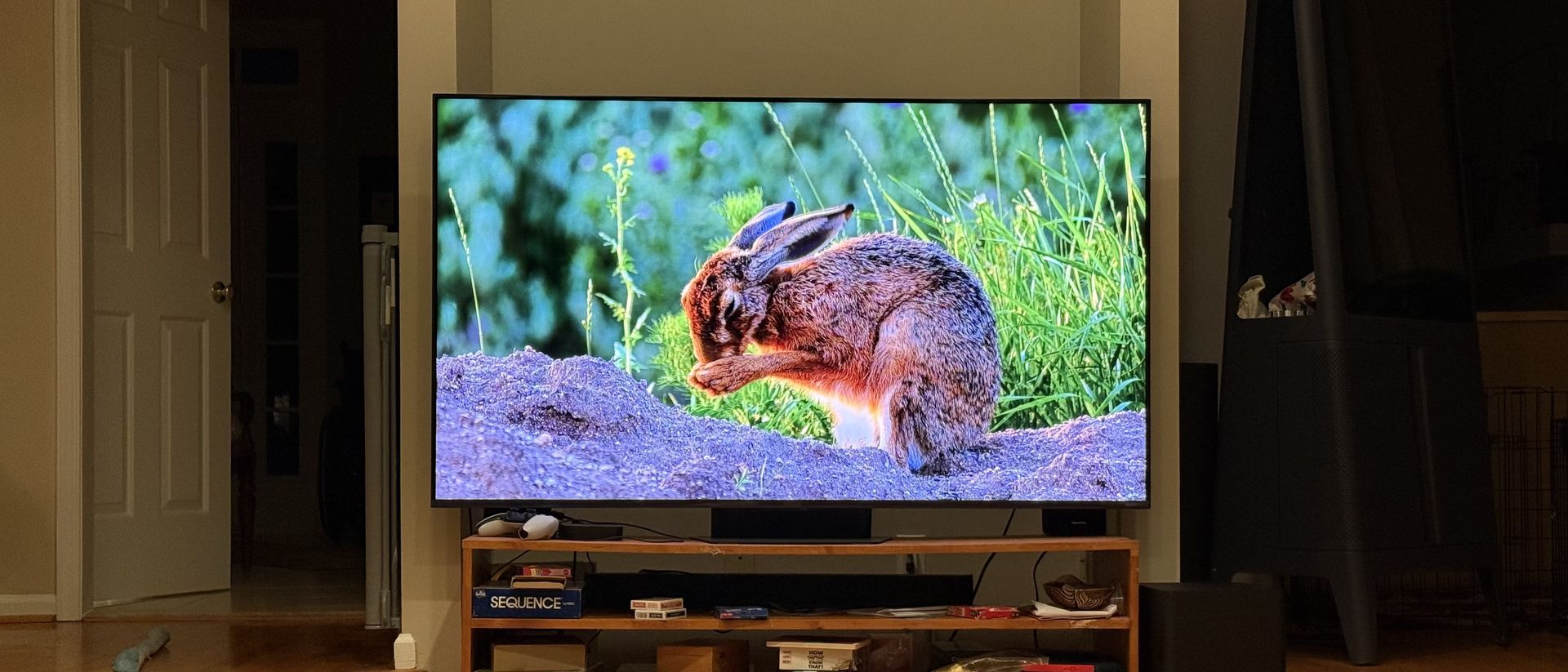 The Hisense UR9 is the company’s RGB LED effort, and it’s quite the TV. But you’ll pay for being an early adopter. Read More Latest from TechRadar US in Reviews